Tuesday, June 14, 2022

Pride Sunday 2022: Of Audacious Goals and Incremental Victories

Pride Sunday 2022 | All Saints Church, Pasadena | June 12, 2022

AKA Trinity Sunday  Proverbs (8:1–4, 22-31); John (16:12–15)


Drawn by thy quickening grace, O Lord,
in countless numbers let them come
till with this Bread shall all be blest
who see the light or feel the sun.

It was August 1998 and I was a brand new priest serving as the Associate Rector at St. Peter's in San Pedro. It was the Sunday after the Lambeth Conference of Anglican Bishops had adopted resolution Lambeth 1.10 declaring homosexuality "incompatible with scripture" -- and as the bread and wine was brought forward to the altar -- I stood behind it with tears streaming down my face as I tried to sing those words ... gutted by the disconnect between the words of the hymn and the actions of the church. 

·      Where was there room for quickening grace in the face of oppressive systemic homophobia?

·       What about the countless numbers of God' beloved LGBTQ people who heard the bishops who were called to be shepherds of the flock say there was no place for queer sheep at this table?

·       And how, oh how, were we going to muster the energy, power, drive or resources to engage in the kind of struggle it was going to take to overcome such a massive setback?

And so we wept. 
And then we persisted.

In December 1998, our own Episcopal Diocese of Los Angeles took the step -- which others would follow -- of adopting a resolution at our diocesan convention "declining to receive" Lambeth Resolution 1.10 as being contrary to our baptismal promise to respect the dignity of every human being. In 2000 our General Convention adopted a resolution opening the way to the blessings of same-sex covenants -- and eventually to marriage equity. In 2003 Gene Robinson became the first openly gay bishop ... emphasis on the openly ... in the Anglican Communion.

The struggle to become a church where full inclusion is not just a resolution we adopt but a reality we live has continued -- sometimes an inch at a time -- sometimes two steps forward and one step back -- all toward the goal of the church becoming the Beloved Community reflected in today's words of Wisdom from Proverbs:


I was God’s delight day after day,
rejoicing in being in God’s presence continually,
rejoicing in the whole world
and delighting in humankind!

Delighting in humankind -- wonderfully and marvelously made is all its extravagant diversity -- each and every one us made in the image of the God who loved us enough to become one of us in order to show us how to love one another.

Where the church has too often gotten it wrong -- and continues to get it wrong -- is when it conflates AN image of God for THE image of God ... and then starts creating dogmas and doctrines and structures and strategies to protect "the" image at all costs ... rather than delighting in humankind in all its glorious diversity.

Which could lead me -- on this Trinity Sunday -- to launch into a discourse on the mysteries of doctrine of the Trinity ... up to and including how veneration of the narrowly binary male-centric language finite human beings came up with in an attempt to describe the infinite creator of all being led to the deification of maleness and the entrenchment of a patriarchal worldview that has done nothing to serve the Good News of God's inclusive love available to absolutely everyone proclaimed by the radical rabbi from Nazareth.

But I'm not going to go there today. More on that on July 3rd -- when I plan to preach about reclaiming both our theology and our democracy from toxic patriarachalism. Mark your calendars.

Today, however, is the day we celebrate Pride Sunday -- which is many things to many people -- and one of those things is a day to celebrate the struggle.

It is a day to mark how far we've come as a church and as a nation in the journey toward both full inclusion and equal protection for every single beloved child of God ... no matter where they fall on the continuum of gender identity or sexual orientation ...
 no matter what letter they claim in the LGBTQ+ alphabet song.

It is a day to regroup, recharge and recommit ourselves to continue that struggle – for even while we mark with pride and gratitude the tremendous progress that has been made, we recognize that there is still work to do: not only to continue to move forward, but to challenge those who would push us back.

It is an opportunity to remember the work of those on whose shoulders we stand; AND it is an opportunity to harness the celebratory energy Pride creates to get back to the work of the fight that remains before us.

George Regas -- our rector emeritus of blessed memory -- described that work with these words:

We live out the Gospel in the world
by setting audacious goals
and celebrating incremental victories.

On this Pride Sunday 2022, the audacious goal we have set before us is nothing less than the kingdom come on earth as it is in heaven we pray for every time we gather –  a world where respecting the dignity of every human being is not just a promise we make but a reality we live.

It is work we are all called to as members of the Body of Christ in the world –  called to love God and love our neighbors as ourselves.

And this morning I think of all those who have gone before us ... tilling the soil and planting the seeds of radical inclusion and courageous justice ...  prophetic leaders in our own Episcopal Church:

Like
 Presiding Bishop Ed Browning – who opened a new chapter when he declared “In this church there will be no outcasts.”

Like Priest and Poet Malcolm Boyd – whose “Are You Running with Me Jesus” fed the hunger of a generation of people who had given up on the church or anyone connected with it having anything relevant to say.

Like Jim White: Who walked in the first L.A. Gay Pride parade in 1970 (one year after the Stonewall riots happened) with no bands, no politicians -- or bishops -- in convertibles.
No one watching from the sidewalks except some random families who had come to Grauman's Chinese to see a matinee.

And I think of Daniel Howells of blessed memory: 
who marched in 1990 the L.A. Pride Parade in an alb with a processional cross – taking it upon himself to represent the Diocese of Los Angeles. And by 1991 we had an organized presence in the parade and by 1992 there was an official Bishop’s Commission for LGBT ministry in the Diocese of Los Angeles.

These stories are but the tip of the iceberg of the great cloud of witnesses on whose shoulders we stand this morning as we continue the work they have passed off to us.

 On this Pride Sunday 2022 the awesome truth is that we have MUCH good news to tell … and we live and move and have our being in a culture literally dying to hear it.

To hear that they are loved. 
To hear that they are welcome. 
To hear that those who pass "Don't Say Gay" bills and attack LGBTQ youth in general and transgender and non-binary kids in particular do not speak for us and do not speak for Jesus.

La lucha continua -- the struggle continues -- and the struggle is real.
And yet  ... here we are.

On Friday night we had a Gay Prom here on the quad lawn at All Saints Church.

On Saturday we ordained Tim Hartley into the sacred order of deacons ... with his City Councilman-elect husband and ridiculously fabulous sons by his side.
 
And today we are gathered here to celebrate a Pride Sunday that includes the baptism of August Quinn -- as the Progress Pride flag flies proudly over the Northwest door and is draped on this pulpit ... and the Spirit of Wisdom is right here with us ...
delighting in humankind in all its extravagant diversity.

If you'd told new-priest Susan who stood weeping behind that San Pedro altar in 1998 that in twenty-four years later all that would be possible I'm not sure she would have believed you.

And yet ... here we are.
Audacious goal still on the horizon  to be sure --|
but SO many incremental victories to celebrate. 

That’s the Good News of God in Christ Jesus AND the Episcopal Church that we have each and every one of us been commissioned to proclaim and that is the work to which we have been called to do.

I want to close with these words from Barbara Mudge – the one-time Vicar of St. Francis in Simi Valley  -- who ended every service with these words of dismissal:

The holiest moment is now – 
fed by word and sacrament
go out to be the church in the world.

In a moment we will turn our attention to this altar – the center of our life in Christ – to be fed by the bread made holy … strength for the journey and sustenance for the struggle ...

the struggle of choosing to be church, even when it is hard;
of choosing to reclaim that inch of the planet in front of us;
of choosing to make God’s justice roll down like waters;
of choosing to love absolutely every one of our neighbors as ourselves;
and of refusing to rest until all who are hungry have been fed.

Drawn by thy quickening grace, O Lord,
in countless numbers let them come
till with this Bread shall all be blest
who see the light or feel the sun.

Now -- let’s go be church.
Amen.


Sunday, June 05, 2022

Pentecost 2022: A Statement on Baptism and Eucharist in The Episcopal Church

On this Day of Pentecost, I am honored to be amongst the great cloud of witnesses signing onto this letter on baptism and communion, addressed to the respective Chairs of the House of Bishops or House of Deputies Committees on Constitution and Canons or Prayer Book, Liturgy and Music.

It suggests some options to consider as they address the issues of Communion and Baptism at the upcoming 80th General Convention of the Episcopal Church -- and I believe it calls us to our best selves as members of a church which is blessed with the DNA of Anglican comprehensiveness coursing in our ecclesial veins.

As the letter notes, I signed as an individual -- not representing either my parish or diocese. But to be clear,  I serve a congregation (All Saints Church, Pasadena) which has had an open table since the 1980's and the days of our Rector Emeritus George Regas and I serve as Canon for Engagement Across Difference in the Diocese of Los Angeles, where we are committed to creating bridges that span differences ... not building walls that exacerbate divisions. 

So when I was asked to consider adding my name to this letter, they had me at "It feels as though there are two opposing camps on the topic of “open communion,” choosing up sides and talking past each other."

I believe we can, should and must do better than that ... and so I hope these words will be received as part of that work of finding a better way to move forward together in these perilous times when our beautiful and broken world so desperately needs the Good News of God's love, justice and compassion we have to offer.

====================

June 5, 2022 |  Day of Pentecost
A Statement on Baptism and Eucharist in The Episcopal Church

 As Jesus was walking along, he saw a man called Matthew sitting at the tax booth; and he said to him, “Follow me.” And he got up and followed him. And as he sat at dinner in the house, many tax collectors and sinners came and were sitting with him and his disciples. When the Pharisees saw this, they said to his disciples, “Why does your teacher eat with tax collectors and sinners?” But when he heard this, he said, “Those who are well have no need of a physician, but those who are sick. Go and learn what this means, ‘I desire mercy, not sacrifice.’ For I have come to call not the righteous but sinners.” —   Matthew 9:9-13


Dear Bishop Klusmeyer, Bishop Lee, Dr. Meyers, and Canon Simmonds Ballentine,

Greetings on this Feast of the Pentecost.

We are writing on behalf of ourselves and not our respective churches, dioceses or institutions. We are a group of church folks, lay and ordained, scholars, and seminary professors. We write out of deep concern at the vehemence of opposition to C028(“All Are Welcome At The Table”), particularly a letter from twenty-two of our colleagues. Some of us are from the Diocese of Northern California which has sponsored this resolution.

The resolution in question proposes to repeal the Canon I.17.7, which states: “No unbaptized person shall be eligible to receive Holy Communion in this Church.”

Many of the signatories are friends whom we respect. We agree with them that baptism is the “fountain from which the other sacraments flow” and that Holy Baptism and Holy Eucharist are “a gift of supernatural grace.”

But on this Day of Pentecost, we are especially aware that the gifts of supernatural grace from the Holy Spirit do not always come in the neat order required by canons.

It feels as though there are two opposing camps on the topic of “open communion,” choosing up sides and talking past each other.

We therefore have the following proposal for you (and others to consider):

1 -    Refer C028 to the Standing Commission on Liturgy and Music to examine the underlying biblical, theological and liturgical issues, history and practical impact of Canon I.17.7, including whether eligibility requirements for the sacrament of Holy Communion appropriately belongs in the canons.

 2 -    Ask the commission to consider developing an invitational rubric to Communion in the Book of Common Prayer.

 3 -    Ask the commission to consider replacing the language of the canon with a positive statement affirming that the fullest meaning of our Holy Eucharist is lived out through our Baptismal Covenant.

We fully support the resolution passed in 2012 by General Convention (2012-C029) stating: “That the Episcopal Church reaffirms that baptism is the ancient and normative entry point to receiving Holy Communion and that our Lord Jesus Christ calls us to go into the world and baptize all peoples.”

We believe that the 2012 resolution wisely recognized that while the “normative” entry point to Holy Communion is baptism, there are other entry points as well.

Those of us who have served in local churches are aware of instances where the unchurched have been drawn to baptism only after first receiving Holy Communion. We have experienced how the Holy Spirit does not always work in linear ways or respect the “good order” of the Church.

The crux of the present issue does not stem from a lack of respect for and belief in baptism. Rather, it stems from how the 1979 Book of Common Prayer eliminated the requirement that a person must be confirmed to receive Communion. The 1979 prayer book remained silent about any other eligibility requirements for receiving Communion. The canon requiring baptism was adopted at a subsequent General Convention.

At worst, eliminating Canon I.17.17 brings us back to where the prayer book left us in 1979.

We are concerned that the language of the canon carries a tone of control and gatekeeping. That the canon begins with the word “No” underscores how this canon is essentially a negative rule rather than an invitation to the grace of the sacraments.

The current canon has the unintended effect of diminishing both sacraments. The canon makes it sound as if one sacrament — Baptism — is a dinner ticket to the other sacrament — Communion.

In practical terms, the canon is virtually unenforceable. No priest or bishop we know checks for baptismal certificates at the altar rail. No priest or bishop we know has been disciplined for serving Communion to an unbaptized person.

As followers of Jesus, we resist such barriers to those seeking the grace and mercy of the sacraments from whatever doors they enter.

We are also concerned that the letter writers assert that “God’s people” are restricted only to the baptized. That assertion has a narrow, tribal tone that does not serve our church well. Moreover, their assertion, perhaps unintentionally, creates a barrier to interfaith relations.

Indeed, when the presider at the Holy Eucharist raises the elements and proclaims the words “The Gifts of God for the People of God,” we hear in that an invitation to all of humanity. For as the apostle Paul wrote in the Letter to the Romans 8:14, which we hear on this Pentecost Day, “All who are led by the Spirit of God are children of God.”

Faithfully submitted, through the Grace of Our Lord Jesus Christ,

Dr. Diana Butler Bass, Ph.D.  
Author and historian 
Diocese of Virginia

The  Very Rev. Penny Bridges
Dean, St Paul’s Cathedral, San Diego
Diocese of San Diego

The Very Rev. Dr. Donald G. Brown
Dean Emeritus, Trinity Episcopal Cathedral, Sacramento
Diocese of California

The Rev. Dr. Linda Lee Clader
Professor Emerita, Church Divinity School of the Pacific
Diocese of Northern California

The Rev. Cookie Clark
Deacon, Church of the Epiphany, Vacaville
Clergy Deputy
Diocese of Northern California

The Rev. Robin Denney
Rector, St. Mary’s Episcopal Church, Napa
Clergy Deputy
Diocese of Northern California

Jay Elmquist
Trinity Episcopal Cathedral, Sacramento
Lay Deputy
Diocese of Northern California

The Very Rev. Gail Greenwell
Dean of Christ Church Cathedral, Cincinnati, retired
Diocese of Southern Ohio

The Rev. Dr. Robert Gregg
Professor and University Chaplain Emeritus,
Stanford University

The Rev. Canon Rosa Lee Harden
Executive Producer, Faith+Finance
Asheville, North Carolina

Peter Juve
Saint Mary’s Church, Napa
Lay Deputy
Diocese of Northern California

The Very Rev. Nathan LeRud
Dean, Trinity Episcopal Cathedral, Portland
Diocese of Oregon

The Rev. Dr. Daniel DeForest London, Ph.D.
Rector, Christ Episcopal Church, Eureka
Diocese of Northern California

The Rev. Dr. Rebecca Lyman,
Samuel Garrett Professor of Church History, emerita
Church Divinity School of the Pacific
Diocese of California

Canon Charles R. Mack, Chancellor Emeritus and Vice Chancellor
First Lay Alternate Deputy
Diocese of Northern California

The Very Rev. Kristi Maulden
Dean, Cathedral of St John, Albuquerque, New Mexico
Episcopal Diocese of the Rio Grande

The Very Reverend Ronald D. Pogue
Dean (interim, retired), Saint John’s Cathedral, Denver Colorado
and St. Andrew’s Cathedral, Jackson, Mississippi
Diocese of Texas

The Rev. Br. Simeon (Lewis) Powell, C.G.
Clergy Deputy, and Chair of the Deputation
Diocese of Northern California

The Rev. James Richardson
Former Associate Dean and Interim Dean, Trinity Episcopal Cathedral, Sacramento
Former Rector, St. Paul’s Memorial Church, Charlottesville, Virginia
First Clergy Alternate Deputy
Diocese of Northern California

The Rev. Canon Susan Russell
All Saints, Pasadena
Diocese of Los Angeles

The Rev. Dr.  Susanna Singer, Ph.D.
Professor Emerita of Ministry Development
Church Divinity School of the Pacific
Diocese of California

The Rev. Dr. P. Donald White, Jr.
Former Chair, Board of Trustees, Church Divinity School of the Pacific
Diocese of Louisiana

DonnaJo Woollen
Emmanuel Church, Grass Valley, California
Lay Deputy
Diocese of Northern California 


Saturday, May 21, 2022

es.sen.tial [noun] "a thing that is absolutely necessary"*

*Merriam Webster

Deciding what is essential ... what is "absolutely necessary"... is tricky business. What is essential to me might be expendable to you and vice versa. And yet, sometimes we have to make those choices together -- even though it will be tricky.

Which is exactly where the Episcopal Church finds itself in this moment, as those empowered to make decisions on behalf of the whole church are working to make decisions about what is "essential business" for our upcoming, already postponed once and now abbreviated 80th General Convention.

The focus of the work of convention was described as a “short, focused meeting, to hold elections, approve a budget and address other critical issues and essential legislation that cannot wait until 2024”  in the May 11 Episcopal News Service article summarizing the work of the most recent meeting of Executive Council.

All of this is out of the laudable concern for protecting the health and safety of the Deputies and Bishops from the COVID-19 virus as they gather under the shadow of the ongoing challenge of this global pandemic.

And so as the plans are being made to decide what will or will not rise to the level of "critical issues and essential legislation" I write today in the service of what I believe is another laudable concern: protecting the health and safety of the whole church as it continues to meet the ongoing challenge of other viruses that infect our human family -- including but not limited to systemic racism and the rising tide of homo/trans-phobia variants which continue to marginalize and terrorize God's beloved LGBTQ children.

I write in hope that the important work represented by resolutions calling the church to continue the Gospel work of dismantling oppression in all its forms (see also Luke 4:18) will not end up on the COVID cutting room floor, but will be considered as critical issues that cannot wait until 2024.

Let us be a church where we prioritize the health and safety of the most marginalized as intentionally as we prioritize the health and safety of those we have elected to make decisions for us in the councils of the church.
Almighty and everliving God, source of all wisdom and understanding, be present with those who take counsel in the General Convention of the Episcopal Church for the renewal and mission of your Church. Teach us in all things to seek first your honor and glory. Guide us to perceive what is right, and grant us both the courage to pursue it and the grace to accomplish it; through Jesus Christ our Lord. Amen. (BCP Page 818)


Thursday, April 14, 2022

Holy Week Memory Lane: 25th Renewal of Clergy Vows

[Tuesday, April 12, 2022] Heading off this morning to St. John's Cathedral for the annual Tuesday-in-Holy-Week-Renewal-of-Clergy-Vows. I just did the math (something I usually avoid doing!) and realized this is the 25th time I've made this trek with the rest of my clergy siblings here in the Diocese of Los Angeles. And I'm remembering as if it was a few months ago -- not a quarter century (how on EARTH did that happen so fast???) ago -- my first Renewal of Vows. 

I was a transitional deacon whose ordination to the priesthood had been delayed by a Standing Committee which was not satisfied with the answers they got from my then-bishop +Fred Borsch and me about my coming out process. Having pulled their approval in December for the scheduled January ordination, when Holy Week rolled around, I was the last transitional deacon standing ... and to put it mildly, it was not the best of times.

I was therefore not inclined to go show up with the rest of my cohort and risk what I expected would be questions, sidelong glances and probably well meaning pity. But wiser heads prevailed and off I went -- remembering the words of Liz Habecker: "Sometimes you win and sometimes you lose but you always suit up."

And so I suited up -- and when I came up the elevator into the lobby of Cathedral Center and the door opened to a crowd of my vested colleagues, I almost hit the "down" button to escape ... but there was Mitties DeChamplain of blessed memory who immediately grabbed my arm and said "Oh there you are! Won't you be my date this morning?" And she helped me vest and walked with me in the procession and told me "all will be well" ... and it was.

There was that memorable moment (to me) when it was time for the actual renewal of vows part where the bishop asks the clergy to rise -- first the deacons and then the presbyters -- and I realized when it came time for the deacons there would be just two of us. (We only had one vocational deacon in the diocese at that point, believe it or not!) But I got through that part and sat down ... and remember as if it was yesterday the pastoral support in the eyes of Fred Borsch who was a mensch if there every was one. And then I remember the great "whoosh" in the room as all the other clergy stood around me.

And I also remember the friendship, mentorship and support of all those who stood by in that "not the best of times" and with whom I've had the privilege of serving over these last 25 years ... especially giving thanks this morning (In addition to +Fred and Mitties) for Liz Habecker, Lynn Jay, Warren Nyback, +Chet Talton, Alan Richardson, Hartshorn Murphy, Mark Kowalewski, Kay Sylvester, Charles Sacquety, Joanna Satorius, Tony Jewiss & Barbara Mudge.

So here I go again. Down the 110 to Adams Blvd. to another Tuesday in Holy Week Renewal of Clergy Vows. And for all the challenges and changes and chances of this crazy vocation where we suit up in weird vestments and presume to offer ourselves to serve as icons of the priesthood of all believers I can't imagine having a greater privilege than being called to do this work in this place with these colleagues over these last 25 years.

And of all the lessons I've learned, the one I'm remembering this morning is the one I learned from Liz and we've all learned 100 times over during this time of pandemic and challenge: "Sometimes you win and sometimes you lose but you always suit up."

And when the time comes for us all to stand and renew our vows before our bishop, I'll remember -- once again -- what it felt like to be the one left sitting ... and that until there are no strangers left sitting (or standing at the gate) la lucha continua.

 Onward and upward ... Holy Week Blessings, Church!

[photo credit: Janet Kawamoto, Episcopal Diocese of Los Angeles]

Friday, March 25, 2022

Integrity USA Post Mortem


Well, it's official. In a press release received earlier today, Consultation Convener Laura Russell announced the official dissolution of Integrity USA and its withdrawal from the progressive Episcopal consortium:
The Consultation, a consortium of progressive organizations in the Episcopal Church, has received word that Integrity, Inc. has withdrawn its membership in The Consultation. Integrity has been a charter member of the Consultation since 1985.

On March 21, Ronnie Ward, president of both Integrity, Inc. and Integrity Americas, Inc., notified Consultation convener Laura Russell, “Since Integrity, Inc. is now in the post-dissolution winding-up phase, the organization is withdrawing as a constituent member of The Consultation and will not be sending a representation.” The dissolution of Integrity, Inc.’s corporate status began in January and the withdrawal is part of that process.

Russell responded, “We sincerely regret losing one of our charter members.”
The Decline & Fall of Integrity USA has been an ongoing process for over a decade. In the years since Louie made that first fateful 1974 phone call to Grace Cathedral, the organization founded in response to his call to "restore Integrity" to TEC regarding God's LGBTQ beloved served brilliantly at times -- and blunderingly at others.

Like the old wineskin of parable fame, its organizational structure had outlived its efficacy as a container for the new wine of LGBTQ activism necessary to meet the challenges we face as we continue the work of dismantling all that stands in the way of making full inclusion not just a resolution but a reality.

One contextual reminder is that Integrity was for most of its existence not the "only game in town" in the Episcopal Church working for LGBTQ inclusion. The Oasis Ministries, Beyond Inclusion, Claiming the Blessing, the Chicago Consultation & various diocesan and parish based advocacy organizations worked long and hard -- and if we're honest, sometimes at cross-purposes and competitively -- to bring us to where we are today: far from where we started and not yet done.

So moving ahead, there will -- I believe -- similarly be room for multiple ways to work together. The end of one nonprofit is neither the end of the world nor the end of the movement.

Yet today's news is a moment to pause and mark the end of a chapter in that work that continues. For many it is a moment marked with both grief and relief as we hold in tension both the good works and failings of the past -- and recommit ourselves to the work that is more important than any individual or organization. 

It is also a good chance to share this 2 minute history of "how we got from there to here" ... beginning in 1974. No history that short can be comprehensive -- but it does provide an overview of both the legislative and programmatic history which I hope will be useful to consider as we think about next steps and therefores as we move together into God's future.

R.I.P., Integrity USA. La lucha continua!


Everything I Needed to Know About Resisting Oligarchy I Learned in the Anglican Inclusion Wars


Everything I needed to know about resisting the forces working to dismantle our constitutional democracy I learned in the trenches of the Anglican Inclusion Wars, as we resisted the forces working to dismantle the Episcopal Church.

I learned that there is no compromising with those who believe they have Sole Possession of the Absolute Truth.

I learned that while we were meeting to negotiate how we would move forward together in spite of our differences, they were orchestrating an exit-strategy that involved litigation, property disputes and the demonization anyone and anything that challenged their patriarchal worldview.

I learned that the same theocratic zealotry that infused the Puritans who abandoned the Church of England because of its comprehensiveness in the 17th century was ironically alive and well in the 21st century -- attempting to reinvent Anglicanism in its own image: straight, White, male-dominated and biblical literalist.

I learned that part of their playbook was to attempt to gaslight the rest of us into the fiction that they were the ones who were the victims here -- an assertion that flies in the face of the reality that there is an ontological difference between feeling excluded because you are disagreed with and being excluded because of who you are.

And I learned that unexamined privilege can be an insurmountable impediment to embracing diversity as a gift rather than attacking it as a threat.

Nevertheless, we persisted.
We resisted.
And now it's time to board up and do it again.

It is time to use all that we learned in the Anglican Inclusion Wars to resist the Christian Nationalist assault on our constitutional democracy ... an assault brought front-and-center this week with the breaking news of the text thread between SCOTUS spouse Ginni Thomas and former White House Chief of Staff Mark Meadows.

If you need some background, there's this March 14, 2022 CNN piece which begins:
"Conservative activist Virginia "Ginni" Thomas said in an interview published Monday that although she attended a rally on January 6, 2021, she "played no role" in planning the events that day and that she doesn't involve her husband, Supreme Court Justice Clarence Thomas, in the political work she does pushing conservative causes."
But then there was this Washington Post opinion piece by Greg Sargent [March 25, 2022]:
"Buried in the explosive news that Virginia Thomas aggressively advocated for Donald Trump’s coup attempt is a choice revelation: The spouse of Supreme Court justice Clarence Thomas texted with White House chief of staff Mark Meadows about Jesus Christ’s otherworldly role in delivering the election to Trump.

Meadows texted to Ginni Thomas that the “King of Kings” would ultimately “triumph” in the quest to overturn the election, which Meadows characterized as “a fight of good versus evil.” Thomas, a longtime conservative activist, replied: “Thank you!! Needed that!”

“Think about the sickness of this,” Joe Scarborough said Friday. “He summons the name of Jesus Christ for his help in overturning American democracy!”

The sentiment is understandable. But what this level of shock really indicates is this: We haven’t paid enough attention to the role of right wing Christian nationalism in driving Trump’s effort to destroy our political order, and in the abandonment of democracy."
And there was this from a March 24, 2022 segment on The Last Word with Lawrence O'Donnell:


"There are no rules in war."

Actually, there are. They're known as International Humanitarian Law and we're seeing Putin break them all in his assault on Ukraine -- not because there are no rules but because he does not believe those rules apply to him. Just as the January 6 Insurrectionists did not believe the rules applied to them. And Ginni Thomas does not believe the rules apply to her.

These are not just good people of deep faith with different opinions than ours.

These are not just politics-as-usual people.  

These are cut-the-baby-in-half if we can't have it, "there are no rules in war" people whose conviction that they have Sole Possession of the Absolute Truth makes them a danger we cannot afford to ignore if we're doing to keep our constitutional democracy from devolving into a theocratic oligarchy.

This is not a drill.
Resist. Persist. Repeat as necessary.
La lucha continua

=============

A footnote: While Ginni Thomas converted to Catholicism in 2002, she was an active parishioner at Truro Episcopal Church in Fairfax, Virginia ... where Martyn Minns was in the forefront of the Inclusion Wars and which eventually left the Episcopal Church, joining the Convocation of Anglicans in North America (CANA).


Monday, January 31, 2022

Public Theology or Moth to the Flame? You Be the Judge.

Knowing when to hold them and when to fold them is a key lesson poker players learn. Knowing when to engage in online debate in the service of theological discourse and when to decline to play the role of moth to the flame is a key lesson public theologians learn. And whoever you are and wherever you fall on either of those continuums, they are arguably lessons you keep on learning -- over and over and over again.

The most recent example in my little corner of the continuum was Sunday's unfortunate NYT op-ed with the click-bait title Why Churches Should Drop Their Online Services.

I'll admit I only read it because I was scrolling down the page to get to the Spelling Bee ... but once I did I immediately started to write my response in my head. I have been at this long enough to pause and at least ask myself the "moth to the flame" question. In this case, myself answered "go for it" -- and so I did: sharing my critique of both the context and conclusion of the piece on social media and with some lively discussion resulting.

The op-ed was written by Tish Harrison Warren -- a priest in the Anglican Church in North America: an author and frequent contributor to the NYT Opinion page. The piece in question is linked above ... but it is behind the NYT paywall. So in case you're not a subscriber, here's a quote that gives you the gist of the author's premise:

“One might ask, why not have both? Why not meet in person (with Covid precautions in place) but also continue to offer the option of a live-streamed service? Because offering church online implicitly makes embodiment elective. It presents in-person gatherings as something we can opt in or out of with little consequence. It assumes that embodiment is more of a consumer preference, like whether or not you buy hardwood floors, than a necessity, like whether or not you have shelter …
No longer offering a streaming option will unfortunately mean that those who are homebound or sick will not be able to participate in a service. This, however, is not a new problem for the church. For centuries, churches have handled this inevitability by visiting these people at home in person.”

And here was my response: 

It figures that the ACNA priest who writes for the NYT would come down on the either/or side of the in-person/on-line worship debate. Sorry, but we live in a both/and world — and if ANY tradition is ontologically wired to meet that challenge it is the actual Anglican/Episcopal one. Forged out of the crucible of the Reformation, we are a church that has historically chosen to be both catholic and protestant. Surely we can be a church that builds community both virtually and physically and not exclude our shut-ins and immuno-compromised siblings from the opportunity to share virtually in our gathered community.

At my parish we’ve been streaming our services for over a decade and going to “in person only” would be an unnecessary diminishment of the value of radical inclusion that we hold as a Gospel imperative. And — for the record — we also welcome, affirm and celebrate LGBTQ+ people as full members of the sacramental life of the Body of Christ. But that’s another op-ed.

Could I have just kept scrolling on down the the Spelling Bee and left well enough alone? Sure. But I would also have missed out on the chance to engage in some lively and enlightening conversation about what makes liturgy the work of the people; what it means to live sacramental lives in a time of virtual community; how we meet the both/and needs of our communities of faith in these complex times without resorting to simplistic either/or answers.

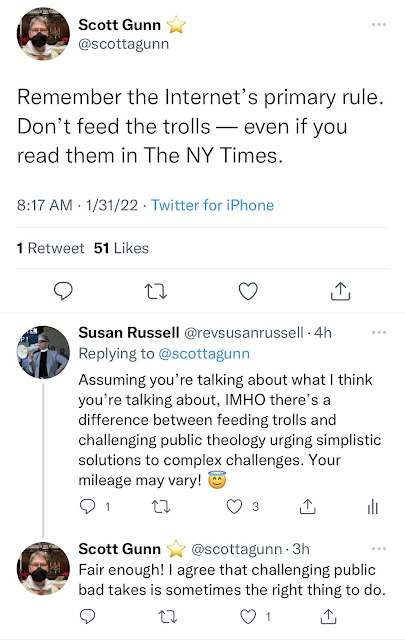
Arguably my favorite exchange was this one on Twitter with friend and colleague Scott Gunn: 


And I'll take that as Game, Set and Match for Public Theology: at least this time!