Saturday, May 21, 2022

es.sen.tial [noun] "a thing that is absolutely necessary"*

*Merriam Webster

Deciding what is essential ... what is "absolutely necessary"... is tricky business. What is essential to me might be expendable to you and vice versa. And yet, sometimes we have to make those choices together -- even though it will be tricky.

Which is exactly where the Episcopal Church finds itself in this moment, as those empowered to make decisions on behalf of the whole church are working to make decisions about what is "essential business" for our upcoming, already postponed once and now abbreviated 80th General Convention.

The focus of the work of convention was described as a “short, focused meeting, to hold elections, approve a budget and address other critical issues and essential legislation that cannot wait until 2024”  in the May 11 Episcopal News Service article summarizing the work of the most recent meeting of Executive Council.

All of this is out of the laudable concern for protecting the health and safety of the Deputies and Bishops from the COVID-19 virus as they gather under the shadow of the ongoing challenge of this global pandemic.

And so as the plans are being made to decide what will or will not rise to the level of "critical issues and essential legislation" I write today in the service of what I believe is another laudable concern: protecting the health and safety of the whole church as it continues to meet the ongoing challenge of other viruses that infect our human family -- including but not limited to systemic racism and the rising tide of homo/trans-phobia variants which continue to marginalize and terrorize God's beloved LGBTQ children.

I write in hope that the important work represented by resolutions calling the church to continue the Gospel work of dismantling oppression in all its forms (see also Luke 4:18) will not end up on the COVID cutting room floor, but will be considered as critical issues that cannot wait until 2024.

Let us be a church where we prioritize the health and safety of the most marginalized as intentionally as we prioritize the health and safety of those we have elected to make decisions for us in the councils of the church.
Almighty and everliving God, source of all wisdom and understanding, be present with those who take counsel in the General Convention of the Episcopal Church for the renewal and mission of your Church. Teach us in all things to seek first your honor and glory. Guide us to perceive what is right, and grant us both the courage to pursue it and the grace to accomplish it; through Jesus Christ our Lord. Amen. (BCP Page 818)


Thursday, April 14, 2022

Holy Week Memory Lane: 25th Renewal of Clergy Vows

[Tuesday, April 12, 2022] Heading off this morning to St. John's Cathedral for the annual Tuesday-in-Holy-Week-Renewal-of-Clergy-Vows. I just did the math (something I usually avoid doing!) and realized this is the 25th time I've made this trek with the rest of my clergy siblings here in the Diocese of Los Angeles. And I'm remembering as if it was a few months ago -- not a quarter century (how on EARTH did that happen so fast???) ago -- my first Renewal of Vows. 

I was a transitional deacon whose ordination to the priesthood had been delayed by a Standing Committee which was not satisfied with the answers they got from my then-bishop +Fred Borsch and me about my coming out process. Having pulled their approval in December for the scheduled January ordination, when Holy Week rolled around, I was the last transitional deacon standing ... and to put it mildly, it was not the best of times.

I was therefore not inclined to go show up with the rest of my cohort and risk what I expected would be questions, sidelong glances and probably well meaning pity. But wiser heads prevailed and off I went -- remembering the words of Liz Habecker: "Sometimes you win and sometimes you lose but you always suit up."

And so I suited up -- and when I came up the elevator into the lobby of Cathedral Center and the door opened to a crowd of my vested colleagues, I almost hit the "down" button to escape ... but there was Mitties DeChamplain of blessed memory who immediately grabbed my arm and said "Oh there you are! Won't you be my date this morning?" And she helped me vest and walked with me in the procession and told me "all will be well" ... and it was.

There was that memorable moment (to me) when it was time for the actual renewal of vows part where the bishop asks the clergy to rise -- first the deacons and then the presbyters -- and I realized when it came time for the deacons there would be just two of us. (We only had one vocational deacon in the diocese at that point, believe it or not!) But I got through that part and sat down ... and remember as if it was yesterday the pastoral support in the eyes of Fred Borsch who was a mensch if there every was one. And then I remember the great "whoosh" in the room as all the other clergy stood around me.

And I also remember the friendship, mentorship and support of all those who stood by in that "not the best of times" and with whom I've had the privilege of serving over these last 25 years ... especially giving thanks this morning (In addition to +Fred and Mitties) for Liz Habecker, Lynn Jay, Warren Nyback, +Chet Talton, Alan Richardson, Hartshorn Murphy, Mark Kowalewski, Kay Sylvester, Charles Sacquety, Joanna Satorius, Tony Jewiss & Barbara Mudge.

So here I go again. Down the 110 to Adams Blvd. to another Tuesday in Holy Week Renewal of Clergy Vows. And for all the challenges and changes and chances of this crazy vocation where we suit up in weird vestments and presume to offer ourselves to serve as icons of the priesthood of all believers I can't imagine having a greater privilege than being called to do this work in this place with these colleagues over these last 25 years.

And of all the lessons I've learned, the one I'm remembering this morning is the one I learned from Liz and we've all learned 100 times over during this time of pandemic and challenge: "Sometimes you win and sometimes you lose but you always suit up."

And when the time comes for us all to stand and renew our vows before our bishop, I'll remember -- once again -- what it felt like to be the one left sitting ... and that until there are no strangers left sitting (or standing at the gate) la lucha continua.

 Onward and upward ... Holy Week Blessings, Church!

[photo credit: Janet Kawamoto, Episcopal Diocese of Los Angeles]

Friday, March 25, 2022

Integrity USA Post Mortem


Well, it's official. In a press release received earlier today, Consultation Convener Laura Russell announced the official dissolution of Integrity USA and its withdrawal from the progressive Episcopal consortium:
The Consultation, a consortium of progressive organizations in the Episcopal Church, has received word that Integrity, Inc. has withdrawn its membership in The Consultation. Integrity has been a charter member of the Consultation since 1985.

On March 21, Ronnie Ward, president of both Integrity, Inc. and Integrity Americas, Inc., notified Consultation convener Laura Russell, “Since Integrity, Inc. is now in the post-dissolution winding-up phase, the organization is withdrawing as a constituent member of The Consultation and will not be sending a representation.” The dissolution of Integrity, Inc.’s corporate status began in January and the withdrawal is part of that process.

Russell responded, “We sincerely regret losing one of our charter members.”
The Decline & Fall of Integrity USA has been an ongoing process for over a decade. In the years since Louie made that first fateful 1974 phone call to Grace Cathedral, the organization founded in response to his call to "restore Integrity" to TEC regarding God's LGBTQ beloved served brilliantly at times -- and blunderingly at others.

Like the old wineskin of parable fame, its organizational structure had outlived its efficacy as a container for the new wine of LGBTQ activism necessary to meet the challenges we face as we continue the work of dismantling all that stands in the way of making full inclusion not just a resolution but a reality.

One contextual reminder is that Integrity was for most of its existence not the "only game in town" in the Episcopal Church working for LGBTQ inclusion. The Oasis Ministries, Beyond Inclusion, Claiming the Blessing, the Chicago Consultation & various diocesan and parish based advocacy organizations worked long and hard -- and if we're honest, sometimes at cross-purposes and competitively -- to bring us to where we are today: far from where we started and not yet done.

So moving ahead, there will -- I believe -- similarly be room for multiple ways to work together. The end of one nonprofit is neither the end of the world nor the end of the movement.

Yet today's news is a moment to pause and mark the end of a chapter in that work that continues. For many it is a moment marked with both grief and relief as we hold in tension both the good works and failings of the past -- and recommit ourselves to the work that is more important than any individual or organization. 

It is also a good chance to share this 2 minute history of "how we got from there to here" ... beginning in 1974. No history that short can be comprehensive -- but it does provide an overview of both the legislative and programmatic history which I hope will be useful to consider as we think about next steps and therefores as we move together into God's future.

R.I.P., Integrity USA. La lucha continua!


Everything I Needed to Know About Resisting Oligarchy I Learned in the Anglican Inclusion Wars


Everything I needed to know about resisting the forces working to dismantle our constitutional democracy I learned in the trenches of the Anglican Inclusion Wars, as we resisted the forces working to dismantle the Episcopal Church.

I learned that there is no compromising with those who believe they have Sole Possession of the Absolute Truth.

I learned that while we were meeting to negotiate how we would move forward together in spite of our differences, they were orchestrating an exit-strategy that involved litigation, property disputes and the demonization anyone and anything that challenged their patriarchal worldview.

I learned that the same theocratic zealotry that infused the Puritans who abandoned the Church of England because of its comprehensiveness in the 17th century was ironically alive and well in the 21st century -- attempting to reinvent Anglicanism in its own image: straight, White, male-dominated and biblical literalist.

I learned that part of their playbook was to attempt to gaslight the rest of us into the fiction that they were the ones who were the victims here -- an assertion that flies in the face of the reality that there is an ontological difference between feeling excluded because you are disagreed with and being excluded because of who you are.

And I learned that unexamined privilege can be an insurmountable impediment to embracing diversity as a gift rather than attacking it as a threat.

Nevertheless, we persisted.
We resisted.
And now it's time to board up and do it again.

It is time to use all that we learned in the Anglican Inclusion Wars to resist the Christian Nationalist assault on our constitutional democracy ... an assault brought front-and-center this week with the breaking news of the text thread between SCOTUS spouse Ginni Thomas and former White House Chief of Staff Mark Meadows.

If you need some background, there's this March 14, 2022 CNN piece which begins:
"Conservative activist Virginia "Ginni" Thomas said in an interview published Monday that although she attended a rally on January 6, 2021, she "played no role" in planning the events that day and that she doesn't involve her husband, Supreme Court Justice Clarence Thomas, in the political work she does pushing conservative causes."
But then there was this Washington Post opinion piece by Greg Sargent [March 25, 2022]:
"Buried in the explosive news that Virginia Thomas aggressively advocated for Donald Trump’s coup attempt is a choice revelation: The spouse of Supreme Court justice Clarence Thomas texted with White House chief of staff Mark Meadows about Jesus Christ’s otherworldly role in delivering the election to Trump.

Meadows texted to Ginni Thomas that the “King of Kings” would ultimately “triumph” in the quest to overturn the election, which Meadows characterized as “a fight of good versus evil.” Thomas, a longtime conservative activist, replied: “Thank you!! Needed that!”

“Think about the sickness of this,” Joe Scarborough said Friday. “He summons the name of Jesus Christ for his help in overturning American democracy!”

The sentiment is understandable. But what this level of shock really indicates is this: We haven’t paid enough attention to the role of right wing Christian nationalism in driving Trump’s effort to destroy our political order, and in the abandonment of democracy."
And there was this from a March 24, 2022 segment on The Last Word with Lawrence O'Donnell:


"There are no rules in war."

Actually, there are. They're known as International Humanitarian Law and we're seeing Putin break them all in his assault on Ukraine -- not because there are no rules but because he does not believe those rules apply to him. Just as the January 6 Insurrectionists did not believe the rules applied to them. And Ginni Thomas does not believe the rules apply to her.

These are not just good people of deep faith with different opinions than ours.

These are not just politics-as-usual people.  

These are cut-the-baby-in-half if we can't have it, "there are no rules in war" people whose conviction that they have Sole Possession of the Absolute Truth makes them a danger we cannot afford to ignore if we're doing to keep our constitutional democracy from devolving into a theocratic oligarchy.

This is not a drill.
Resist. Persist. Repeat as necessary.
La lucha continua

=============

A footnote: While Ginni Thomas converted to Catholicism in 2002, she was an active parishioner at Truro Episcopal Church in Fairfax, Virginia ... where Martyn Minns was in the forefront of the Inclusion Wars and which eventually left the Episcopal Church, joining the Convocation of Anglicans in North America (CANA).


Monday, January 31, 2022

Public Theology or Moth to the Flame? You Be the Judge.

Knowing when to hold them and when to fold them is a key lesson poker players learn. Knowing when to engage in online debate in the service of theological discourse and when to decline to play the role of moth to the flame is a key lesson public theologians learn. And whoever you are and wherever you fall on either of those continuums, they are arguably lessons you keep on learning -- over and over and over again.

The most recent example in my little corner of the continuum was Sunday's unfortunate NYT op-ed with the click-bait title Why Churches Should Drop Their Online Services.

I'll admit I only read it because I was scrolling down the page to get to the Spelling Bee ... but once I did I immediately started to write my response in my head. I have been at this long enough to pause and at least ask myself the "moth to the flame" question. In this case, myself answered "go for it" -- and so I did: sharing my critique of both the context and conclusion of the piece on social media and with some lively discussion resulting.

The op-ed was written by Tish Harrison Warren -- a priest in the Anglican Church in North America: an author and frequent contributor to the NYT Opinion page. The piece in question is linked above ... but it is behind the NYT paywall. So in case you're not a subscriber, here's a quote that gives you the gist of the author's premise:

“One might ask, why not have both? Why not meet in person (with Covid precautions in place) but also continue to offer the option of a live-streamed service? Because offering church online implicitly makes embodiment elective. It presents in-person gatherings as something we can opt in or out of with little consequence. It assumes that embodiment is more of a consumer preference, like whether or not you buy hardwood floors, than a necessity, like whether or not you have shelter …
No longer offering a streaming option will unfortunately mean that those who are homebound or sick will not be able to participate in a service. This, however, is not a new problem for the church. For centuries, churches have handled this inevitability by visiting these people at home in person.”

And here was my response: 

It figures that the ACNA priest who writes for the NYT would come down on the either/or side of the in-person/on-line worship debate. Sorry, but we live in a both/and world — and if ANY tradition is ontologically wired to meet that challenge it is the actual Anglican/Episcopal one. Forged out of the crucible of the Reformation, we are a church that has historically chosen to be both catholic and protestant. Surely we can be a church that builds community both virtually and physically and not exclude our shut-ins and immuno-compromised siblings from the opportunity to share virtually in our gathered community.

At my parish we’ve been streaming our services for over a decade and going to “in person only” would be an unnecessary diminishment of the value of radical inclusion that we hold as a Gospel imperative. And — for the record — we also welcome, affirm and celebrate LGBTQ+ people as full members of the sacramental life of the Body of Christ. But that’s another op-ed.

Could I have just kept scrolling on down the the Spelling Bee and left well enough alone? Sure. But I would also have missed out on the chance to engage in some lively and enlightening conversation about what makes liturgy the work of the people; what it means to live sacramental lives in a time of virtual community; how we meet the both/and needs of our communities of faith in these complex times without resorting to simplistic either/or answers.

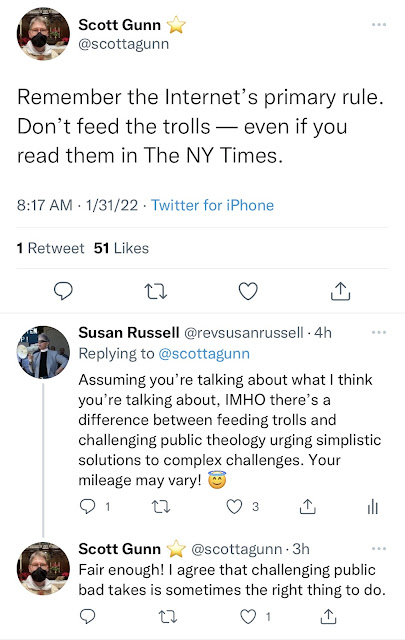
Arguably my favorite exchange was this one on Twitter with friend and colleague Scott Gunn: 


And I'll take that as Game, Set and Match for Public Theology: at least this time! 

Wednesday, January 19, 2022

Biblical Literalism and The Big Lie

If we manage to survive as a human race long enough, a few hundred years from now scores of PhDs will be earned as scholars analyze the combination of social, political, and economic factors which led to the orchestrated assault on our constitutional democracy in general and "The Big Lie" in specific. So, here's a head start:

I am convinced that biblical literalism is a prime cause of the mess we find ourselves in as a nation where a significant percentage of Americans believe the "The Big Lie" that the 2020 election was stolen and the Biden Presidency is a fraud -- in spite of the overwhelming amount of fact based evidence to the contrary.

Yes, there are a complex set of factors that lead to the rise of the populist, nationalist, sexist, xenophobic, white supremacist, homo/transphobic, anti-science, post-fact toxins that have contaminated our body politic and dominated our public discourse.

But incubating those factors into this particular set of toxins requires a kind of cultural Petri dish which will simultaneously provide the nutrients necessary to nourish the toxic worldview while protecting it from contaminates like data, facts, diversity and multi-cultural competency.

The biblical literalism foundational to 21st century American Evangelicalism does precisely that.

It feeds, waters and fertilizes exclusively male language for God -- marginalizing women and non-binary people, perpetuating the patriarchy and fanning the fire of unexamined privilege making a Putin-style oligarchy appear preferable to a democracy where brown and black women have voice and power.

It creates a context where it is a very short journey from “the Bible said it, I believe it, that settles it” to “my country, love it or leave it” – with a direct connection to the rise of nationalism, sexism, white supremacism and the rest of the litany of isms that plague our nation and our world: the rise of the forces we struggle against daily as we live out our baptismal promise to persevere in resisting evil.

And it is this fertile environment that becomes a breeding ground for a population pre-programmed to believe fact-based science is an enemy of faith.

It quite literally lays down neuron tracks in the brain set up to reject as “fake news” the very science that calls us to come together to protect each other from COVID19 and to save what we can of this planet we have exploited -- as well as the fact based reporting of historic levels of corruption and obstruction at the highest levels of our government: including but not limited to perpetuating "The Big Lie" and inciting the January 6 Insurrection.

To be clear: the beauty, power and importance of the First Amendment is that it protects every last one of us to freely exercise the religion of our choice – including the freedom to exercise no religion at all. And including the freedom to reject science, fact and data and to believe whatever one chooses about what God wills, blesses or condemns.

However – and it’s a big however – the First Amendment does not protect the right to confuse the freedom to exercise religion with the license to impose religion. And the job of defending the Constitution against all enemies – foreign and domestic – requires each and every one of us to do our part.

If we are going to save our nation from devolving into a kind of theocratic oligarchy, those who believe that science and data are things – those who embrace the vision of a nation where liberty and justice for all literally means all -- must provide an antidote to the toxins of ignorance and “alternative facts” threatening our constitutional democracy with polarization and division.

Otherwise we risk finding ourselves in the last scene of the last act of “Camelot” -- looking for a boy to run and tell the story of what almost was: a nation conceived in liberty and dedicated to the proposition that all people were created equal.

The stakes are too high, the challenges are too great, and the struggle is too real to do anything less than to stand up, to speak out and to resist the rise of the populist, nationalist, sexist, xenophobic, white supremacist, homo/transphobic toxins contaminating our body politic and dominating our public discourse.

Pick your thing and do it. Now. Together we can make a difference. Together we can overcome.

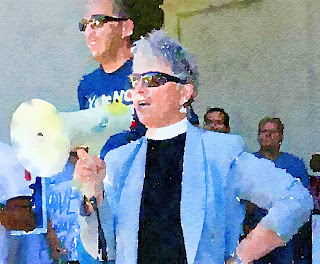
[photo credit: Susan Russell, June 2011: protesters across the street from All Saints Church, Pasadena]    

Wednesday, January 12, 2022

A California Yankee in King Arthur's Communion ... 17 years later!

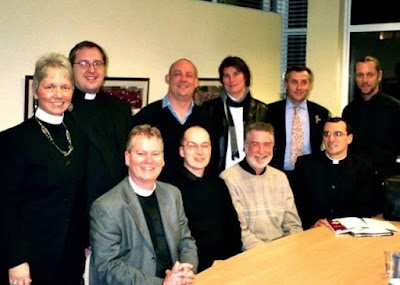
That Was Then (2005)


 This Is Now [2022]
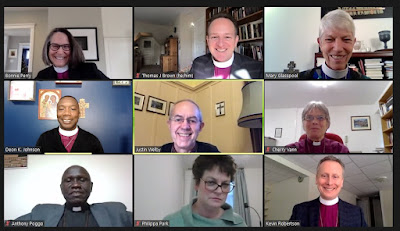
So I was scrolling through Facebook procrastinating something on my January 2022 To Do list and was stopped short by this photo posted on friend Bishop Deon Johnson's Facebook page of a Zoom meeting with several LGBTQ Bishops in the Anglican Communion and Archbishop of Canterbury Justin Welby.

I commented on the post, writing: "Just “Wow!” Seriously. I’m flashing on a meeting LGBT "campaigners" had at the Anglican Communion Office back in the day when the only way they would let us take a picture of the folks gathered was if (a) we didn’t have any ACO signage in the shot and (b) we didn’t identify the staffer who took the picture for us. We may not be “there” yet but we’ve sure come a far piece!"

Then I got inspired to go dig out the photo from that earlier meeting (posted above) ... which reminded me of the reflection I wrote on the plane on the way home which (thanks to the Way Back Machine!) I unearthed and posted below: a little time capsule from 17 years ago at the height of the Anglican Inclusion Wars.

I hope it's a reminder of how far we have come since 2005 on this journey toward becoming more fully the Beloved Community we are called to be even as we wrestle with the seemingly intractable issues and sometimes overwhelming challenges we face in 2022. 

La lucha continua -- the struggle continues. But one of the tools we deploy in the work we are called to do is knowing our history. And one of the resolutions we'll be presenting to the upcoming General Convention calls for the archiving of the history of LGBTQ inclusion in the Episcopal Church. As Rachel would say ... "watch this space!"

==========

A California Yankee in King Arthur's Communion - January 2005
[originally posted to Susan's Blog at everyvoice.net]

A trip to the Anglican Communion Office in London was not on my “to do” list for 2005 … or it wasn’t until late December, when I found a letter from England half-way down the pile of between-Christmas-and-New-Year’s mail stacked up on my desk.

It turned out to be a letter of invitation – extended jointly to Integrity and two UK organizations (LGCM – Lesbian Gay Christian Movement and Changing Attitudes) – for us to officially add our voices to those from around the Anglican Communion being represented to the Primates as part of the Windsor Report Reception process.

It was a significant step forward for a process that had – up until then – declined to receive any official representation from gay and lesbian folk maintaining that our voices were not relevant because the issue at hand was “not sexuality but unity.” The fact that we were -- in the end -- included in the process and had the opportunity to address the issue of unity from the particularity of our experience as gay and lesbian Christians was a step forward and due in very large part to the persistence of the Reverend Colin Coward (of Changing Attitudes).

The letter of invitation, from the Reverend Gregory Cameron, Deputy Secretary General of the Anglican Communion Office and Windsor Report Reception Reference Group Secretary was in part a response to a recent letter from Colin and included the following: "I think that you are absolutely right to put your finger on the fact that a number of Lambeth Conference Resolutions, for a period of thirty years now, on engaging in conversation with this subject on an international level seem to have been ignored. You are also right to point out that the Windsor Report, in paragraphs 135, 145, 146 does say that this conversation must happen. So it becomes a very real concern to me to see how we can persuade the Anglican Communion at its highest level to engage constructively with the existing resolutions and to take this matter forward. I would be very happy, therefore, to have a conversation about an appropriate way of doing this."

And so basically, we were invited to London to be part of a conversation about how we might engage in the conversation to persuade the Communion to have the conversation it has steadfastly refused to have since it committed to it in 1978.

Hmmmm.

And so off we went to London – a very far ways indeed for a conversation on conversation.

I will admit to taking with me across the Atlantic both low expectations and a high degree of suspicion that this might be nothing but an effort (to be blunt) to shut us up by saying, “There, we’ve met with you. Now do run along.” But as I write this reflection (on the return flight home) I am bringing back both a renewed conviction that there are indeed possibilities beyond the current impasse and a renewed sense of hope that our Communion can weather this current storm if we’re willing to work at it.

That being said, I am also increasingly clear that in order to do so we must reject the “urban myth” (perpetuated in no small measure by some of the foundational assumptions of the Windsor Report itself) that we find ourselves in this mess because of the actions of the American and Canadian Churches who unilaterally thrust a hitherto happily unified Communion into a schism-bound tailspin of controversy.

 Rather we cannot ignore the impact of the broken promises of an institution that:

· In 1978 committed to engage in deep and dispassionate study of the question of homosexuality, which would take seriously both the teaching of Scripture and the results of scientific and medical research

· In 1988 urged such study and reflection to take account of biological, genetic and psychological research being undertaken by other agencies, and the socio-cultural factors that lead to the different attitudes in the provinces of our Communion and called each province to reassess, in the light of such study and because of our concern for human rights, its care for and attitude towards persons of homosexual orientation.

· In 1998 recognized that there are among us persons who experience themselves as having a homosexual orientation and declared: "Many of these are members of the Church and are seeking the pastoral care, moral direction of the Church, and God's transforming power for the living of their lives and the ordering of relationships. We commit ourselves to listen to the experience of homosexual persons and we wish to assure them that they are loved by God and that all baptised, believing and faithful persons, regardless of sexual orientation, are full members of the Body of Christ."

In his critique of the Windsor Report, “Broken Promises Result in Broken Communion,” Michael Hopkins writes that there is: "… no analysis of how the near total ignoring of those resolutions outside of the United States and Canada has contributed to the crisis. Indeed, having mentioned these resolutions, the Report goes on to lay the blame on the Episcopal Church and the Diocese of New Westminster in Canada for not “consulting” the Communion. Yet it was the Communion leadership itself that promised to have the conversation for twenty-five years, a promise that remains broken. It should be no surprise to anyone that twenty years of broken promises have produced broken communion."

That is the essence of the collective message we took to St. Andrew’s House for our Tuesday afternoon meeting with Canon Cameron: scapegoating ECUSA, New Hampshire, gay and lesbian Christians in general or Bishop Gene Robinson in particular will not move us through this impasse. To quote Michael Hopkins once more, “Our Communion has been broken because we have broken promises about listening to each other. The only way to heal the brokenness is by listening, by holy conversation. It is not by strengthening authority, as the Windsor Report suggests.”

There were, in the end, ten of us – men and women, gay and straight, lay and ordained and we brought a variety of perspectives and contexts into the conversation: Michael and I representing Integrity USA, Colin and Sally Rogers (Changing Attitudes, England), Kelvin Holdsworth (Changing Attitude, Scotland), Paul Collier (General Synod Human Sexuality Group), Giles Fraser (Inclusive Church), Richard Kirker and Anthony Braddick-Southgate (LGCM), and Bertrand Olivier (Clergy Consultation).

We were deeply aware of the absence of any of our two-thirds-world brothers or sisters – despite best efforts to include their voices at the table. In point of fact, mere days before, Christopher Senteza (Integrity Uganda) had been denied a visa to enter the UK for our meeting – a fact noted in a January 29th article in the Guardian and responded to in a letter to the editor over several of our signatures printed on January 31st:

Just last month, the International Gay and Lesbian Human Rights Commission reported that the persecution of homosexuals in Uganda had intensified following the Anglican church of Uganda's aggressive campaign against homosexuality that was launched as a direct response to the American church consecrating a gay bishop. Throughout Africa, gay Christians are frightened, isolated and desperate. Those who are open about their sexuality are commonly excluded from church life and refused baptism and communion. They can be subjected to verbal abuse by their priests and bishops. Those working for the church are sacked. The Anglican church has committed itself to listen to the voices of lesbian and gay people. Yet the church attacks and excludes them as soon as they make their voices heard. The bishops of the Anglican communion must make it possible for listening to take place and engage in the dialogue that it has been so repeatedly promised.

It would be neither helpful nor possible to recount the contents of a four-hour meeting. However, I will offer some overview impressions.

First of all, I felt that we were genuinely listened to and that the concerns we represented would be (as promised) included in the representations being compiled for the Reception Committee to report to the Primates when they meet later this month. I was and am deeply grateful for both the privilege and the opportunity to be in some small way part of this important process.

Secondly, I was struck by what a broad diversity of experience was represented by this very narrowly white, western sampling of Anglicans. Whether reflecting over a pint or conversing over the meeting table our differences in theology, polity and ecclesiology were sometimes staggering, causing me to wonder whether we mightn’t better be amazed that we’ve ever managed any unity rather than being surprised that we’re currently being challenged by our diversity!

As to a few of the particulars of the conversation, we experienced some genuine surprise at the suggestion that Lambeth Conference Resolution 1:10 was not universally “received” in the first place.

Kelvin Holdsworth was clear that the Scottish bishops quickly distanced themselves en masse from it -- and I shared that in the Diocese of Los Angeles our December 1998 Diocesan Convention passed a resolution (as did other dioceses in ECUSA) declining to receive the portion of the Lambeth Resolution decreeing “homosexuality incompatible with Scripture.” Those actions, along with others, go toward refuting the premise that the actions General Convention 2003 were somehow extraordinary to the point of rupturing the Communion.

What was in fact extraordinary was not the action of Convention but the re-action of a small percentage of those whose vehement dissent manifested itself in a well-financed temper tantrum of global proportions. I said in Minneapolis and I’ll say it again:

If schism happens (and I still do not believe it is inevitable) the responsibility will lie firmly at the feet of those in ECUSA whose criteria for being included is being agreed with – and having been disagreed with one-time-too many by a Church enriched by the ministry of gay and lesbian clergy and blessed by the witness of faithful gay and lesbian couples have determined to either remake this Church of ours into one in their own image or rupture it trying.

There was much discussion about the difference between the process of “reception” of the ordination of women (which precipitated the last great threat to Anglican Unity) and the current situation. The representation I found so disingenuous (and named as such) was painting the gradual coming to terms with women’s ordination over these last thirty years as a case-in-point of how we “ought to have been going about this.”

 Clearly the most influential factor in the eventual level of tolerance-if-not-outright-acceptance of women in ordained ministry was the incarnational experience of women in ministry.

The irony is that if the Windsor Report has its way and some kind of moratorium on ordinations or blessings of relationships is taken forward, the Communion will be prevented from having the same kind of transformational experience of gays and lesbians in ordained ministry; of faithful gay and lesbian couples living in holy, committed relationships. I believe such a moratorium needs to be named as part of the concerted strategy of those who “lost” on the former issue to frame the current debate to preclude such witness in the latter.

Another flaw of the Windsor Report we represented was the attempt to ignore issues of ethics and theology in favor of narrowly discussing ecclesiology. It was acknowledged that it was determined to be so “messy” to try to deal with all the intertwined components of the current debate that isolating one and working it through was a considered choice – a bad one I would (and did) say.

 This image came to me later (and I wished I thought it up at the time): it’s as if the Communion is an automobile that has been running increasingly roughly for a number of years. Finally getting it in the shop, we take out the carburetor and commence to getting it in shape – neglecting altogether the other essential components of the car that have to work in concert in order for the thing to run properly and are suffering from years of deferred maintenance. It seems to me a profoundly narrow, linear, “un-holistic” approach -- both doomed to failure and lacking imagination.

And it’s precisely that imagination we must bring to this next phase of our work together as members of this “Big Fat Anglican Family.” Are we broken at the moment? Absolutely – and let’s not default to some ancestral British “stiff upper lip” place and deny both the pain and reality of that brokenness. Rather let’s imagine admitting our brokenness, to our Lord and to one another, and committing to a time of holy listening, of openness to God’s healing grace, of trust that the historic voices reminding us that as Anglicans we have more in common than we do in difference will, if we listen, be more compelling than the hysterical voices telling us “the sky is falling, the sky is falling.”

Finally, let’s imagine facing our Lord on Judgment Day where Matthew assures us we will be called to account for our actions in this life. Imagine hearing, “Inasmuch as you have articulated a viable ecclesiology” or “Inasmuch as you have enforced the Levitical purity codes” or “Inasmuch as you have preserved the Instruments of Unity.” If we take Matthew at his word, in the end it will have nothing to do with what we did either for or in the church – but what we’ve done for and in the world: what we’ve “done unto the least of these.”

And the least of these are children around the world dying of HIV/AIDS and malaria while we finance commissions and committees to sort out our ecclesial wrangling. The least of these are gay and lesbian people who face persecution, imprisonment and even death for just telling the truth about who they are while we dare to debate whether or not they should be fully included in the Body of Christ. The least of these are those who have not yet heard that the Gospel is meant for them: the plentiful harvest that awaits the Good News of God in Christ Jesus. And the sad truth is that we “too few laborers” are too busy fighting with each other to go out and do the work of evangelism that is our baptismal call.

And it is out of that sad truth that come the sense of possibilities beyond the current impasse and the sense of hope I’m bringing home with me from London – along with the Henry-the-Eighth teapot and Big Ben pencil sharpener in my carry-on bag.

The possibility is that our Communion leadership will refuse to continue to allow the Gospel we share in common to be held hostage to the differences that are being exploited to divide us. The hope is that like the Persistent Widow who is our spiritual ancestor our voices calling the Communion to listen to us – and to each other – will finally be heard and that God’s justice will be served. And the conclusion is that if there’s room for the voice of a California Yankee in King Arthur’s Communion, then there is indeed room for all of us in this Big Fat Anglican Family of Faith.