Wednesday, January 19, 2022

Biblical Literalism and The Big Lie

If we manage to survive as a human race long enough, a few hundred years from now scores of PhDs will be earned as scholars analyze the combination of social, political, and economic factors which led to the orchestrated assault on our constitutional democracy in general and "The Big Lie" in specific. So, here's a head start:

I am convinced that biblical literalism is a prime cause of the mess we find ourselves in as a nation where a significant percentage of Americans believe the "The Big Lie" that the 2020 election was stolen and the Biden Presidency is a fraud -- in spite of the overwhelming amount of fact based evidence to the contrary.

Yes, there are a complex set of factors that lead to the rise of the populist, nationalist, sexist, xenophobic, white supremacist, homo/transphobic, anti-science, post-fact toxins that have contaminated our body politic and dominated our public discourse.

But incubating those factors into this particular set of toxins requires a kind of cultural Petri dish which will simultaneously provide the nutrients necessary to nourish the toxic worldview while protecting it from contaminates like data, facts, diversity and multi-cultural competency.

The biblical literalism foundational to 21st century American Evangelicalism does precisely that.

It feeds, waters and fertilizes exclusively male language for God -- marginalizing women and non-binary people, perpetuating the patriarchy and fanning the fire of unexamined privilege making a Putin-style oligarchy appear preferable to a democracy where brown and black women have voice and power.

It creates a context where it is a very short journey from “the Bible said it, I believe it, that settles it” to “my country, love it or leave it” – with a direct connection to the rise of nationalism, sexism, white supremacism and the rest of the litany of isms that plague our nation and our world: the rise of the forces we struggle against daily as we live out our baptismal promise to persevere in resisting evil.

And it is this fertile environment that becomes a breeding ground for a population pre-programmed to believe fact-based science is an enemy of faith.

It quite literally lays down neuron tracks in the brain set up to reject as “fake news” the very science that calls us to come together to protect each other from COVID19 and to save what we can of this planet we have exploited -- as well as the fact based reporting of historic levels of corruption and obstruction at the highest levels of our government: including but not limited to perpetuating "The Big Lie" and inciting the January 6 Insurrection.

To be clear: the beauty, power and importance of the First Amendment is that it protects every last one of us to freely exercise the religion of our choice – including the freedom to exercise no religion at all. And including the freedom to reject science, fact and data and to believe whatever one chooses about what God wills, blesses or condemns.

However – and it’s a big however – the First Amendment does not protect the right to confuse the freedom to exercise religion with the license to impose religion. And the job of defending the Constitution against all enemies – foreign and domestic – requires each and every one of us to do our part.

If we are going to save our nation from devolving into a kind of theocratic oligarchy, those who believe that science and data are things – those who embrace the vision of a nation where liberty and justice for all literally means all -- must provide an antidote to the toxins of ignorance and “alternative facts” threatening our constitutional democracy with polarization and division.

Otherwise we risk finding ourselves in the last scene of the last act of “Camelot” -- looking for a boy to run and tell the story of what almost was: a nation conceived in liberty and dedicated to the proposition that all people were created equal.

The stakes are too high, the challenges are too great, and the struggle is too real to do anything less than to stand up, to speak out and to resist the rise of the populist, nationalist, sexist, xenophobic, white supremacist, homo/transphobic toxins contaminating our body politic and dominating our public discourse.

Pick your thing and do it. Now. Together we can make a difference. Together we can overcome.

[photo credit: Susan Russell, June 2011: protesters across the street from All Saints Church, Pasadena]    

Wednesday, January 12, 2022

A California Yankee in King Arthur's Communion ... 17 years later!

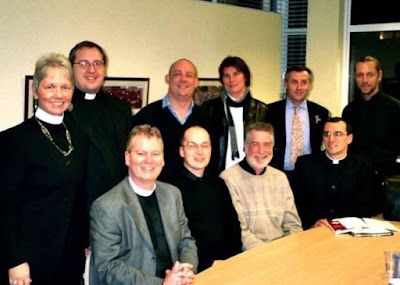
That Was Then (2005)


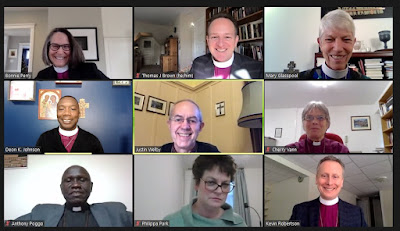
 This Is Now [2022]

So I was scrolling through Facebook procrastinating something on my January 2022 To Do list and was stopped short by this photo posted on friend Bishop Deon Johnson's Facebook page of a Zoom meeting with several LGBTQ Bishops in the Anglican Communion and Archbishop of Canterbury Justin Welby.

I commented on the post, writing: "Just “Wow!” Seriously. I’m flashing on a meeting LGBT "campaigners" had at the Anglican Communion Office back in the day when the only way they would let us take a picture of the folks gathered was if (a) we didn’t have any ACO signage in the shot and (b) we didn’t identify the staffer who took the picture for us. We may not be “there” yet but we’ve sure come a far piece!"

Then I got inspired to go dig out the photo from that earlier meeting (posted above) ... which reminded me of the reflection I wrote on the plane on the way home which (thanks to the Way Back Machine!) I unearthed and posted below: a little time capsule from 17 years ago at the height of the Anglican Inclusion Wars.

I hope it's a reminder of how far we have come since 2005 on this journey toward becoming more fully the Beloved Community we are called to be even as we wrestle with the seemingly intractable issues and sometimes overwhelming challenges we face in 2022. 

La lucha continua -- the struggle continues. But one of the tools we deploy in the work we are called to do is knowing our history. And one of the resolutions we'll be presenting to the upcoming General Convention calls for the archiving of the history of LGBTQ inclusion in the Episcopal Church. As Rachel would say ... "watch this space!"

==========

A California Yankee in King Arthur's Communion - January 2005
[originally posted to Susan's Blog at everyvoice.net]

A trip to the Anglican Communion Office in London was not on my “to do” list for 2005 … or it wasn’t until late December, when I found a letter from England half-way down the pile of between-Christmas-and-New-Year’s mail stacked up on my desk.

It turned out to be a letter of invitation – extended jointly to Integrity and two UK organizations (LGCM – Lesbian Gay Christian Movement and Changing Attitudes) – for us to officially add our voices to those from around the Anglican Communion being represented to the Primates as part of the Windsor Report Reception process.

It was a significant step forward for a process that had – up until then – declined to receive any official representation from gay and lesbian folk maintaining that our voices were not relevant because the issue at hand was “not sexuality but unity.” The fact that we were -- in the end -- included in the process and had the opportunity to address the issue of unity from the particularity of our experience as gay and lesbian Christians was a step forward and due in very large part to the persistence of the Reverend Colin Coward (of Changing Attitudes).

The letter of invitation, from the Reverend Gregory Cameron, Deputy Secretary General of the Anglican Communion Office and Windsor Report Reception Reference Group Secretary was in part a response to a recent letter from Colin and included the following: "I think that you are absolutely right to put your finger on the fact that a number of Lambeth Conference Resolutions, for a period of thirty years now, on engaging in conversation with this subject on an international level seem to have been ignored. You are also right to point out that the Windsor Report, in paragraphs 135, 145, 146 does say that this conversation must happen. So it becomes a very real concern to me to see how we can persuade the Anglican Communion at its highest level to engage constructively with the existing resolutions and to take this matter forward. I would be very happy, therefore, to have a conversation about an appropriate way of doing this."

And so basically, we were invited to London to be part of a conversation about how we might engage in the conversation to persuade the Communion to have the conversation it has steadfastly refused to have since it committed to it in 1978.

Hmmmm.

And so off we went to London – a very far ways indeed for a conversation on conversation.

I will admit to taking with me across the Atlantic both low expectations and a high degree of suspicion that this might be nothing but an effort (to be blunt) to shut us up by saying, “There, we’ve met with you. Now do run along.” But as I write this reflection (on the return flight home) I am bringing back both a renewed conviction that there are indeed possibilities beyond the current impasse and a renewed sense of hope that our Communion can weather this current storm if we’re willing to work at it.

That being said, I am also increasingly clear that in order to do so we must reject the “urban myth” (perpetuated in no small measure by some of the foundational assumptions of the Windsor Report itself) that we find ourselves in this mess because of the actions of the American and Canadian Churches who unilaterally thrust a hitherto happily unified Communion into a schism-bound tailspin of controversy.

 Rather we cannot ignore the impact of the broken promises of an institution that:

· In 1978 committed to engage in deep and dispassionate study of the question of homosexuality, which would take seriously both the teaching of Scripture and the results of scientific and medical research

· In 1988 urged such study and reflection to take account of biological, genetic and psychological research being undertaken by other agencies, and the socio-cultural factors that lead to the different attitudes in the provinces of our Communion and called each province to reassess, in the light of such study and because of our concern for human rights, its care for and attitude towards persons of homosexual orientation.

· In 1998 recognized that there are among us persons who experience themselves as having a homosexual orientation and declared: "Many of these are members of the Church and are seeking the pastoral care, moral direction of the Church, and God's transforming power for the living of their lives and the ordering of relationships. We commit ourselves to listen to the experience of homosexual persons and we wish to assure them that they are loved by God and that all baptised, believing and faithful persons, regardless of sexual orientation, are full members of the Body of Christ."

In his critique of the Windsor Report, “Broken Promises Result in Broken Communion,” Michael Hopkins writes that there is: "… no analysis of how the near total ignoring of those resolutions outside of the United States and Canada has contributed to the crisis. Indeed, having mentioned these resolutions, the Report goes on to lay the blame on the Episcopal Church and the Diocese of New Westminster in Canada for not “consulting” the Communion. Yet it was the Communion leadership itself that promised to have the conversation for twenty-five years, a promise that remains broken. It should be no surprise to anyone that twenty years of broken promises have produced broken communion."

That is the essence of the collective message we took to St. Andrew’s House for our Tuesday afternoon meeting with Canon Cameron: scapegoating ECUSA, New Hampshire, gay and lesbian Christians in general or Bishop Gene Robinson in particular will not move us through this impasse. To quote Michael Hopkins once more, “Our Communion has been broken because we have broken promises about listening to each other. The only way to heal the brokenness is by listening, by holy conversation. It is not by strengthening authority, as the Windsor Report suggests.”

There were, in the end, ten of us – men and women, gay and straight, lay and ordained and we brought a variety of perspectives and contexts into the conversation: Michael and I representing Integrity USA, Colin and Sally Rogers (Changing Attitudes, England), Kelvin Holdsworth (Changing Attitude, Scotland), Paul Collier (General Synod Human Sexuality Group), Giles Fraser (Inclusive Church), Richard Kirker and Anthony Braddick-Southgate (LGCM), and Bertrand Olivier (Clergy Consultation).

We were deeply aware of the absence of any of our two-thirds-world brothers or sisters – despite best efforts to include their voices at the table. In point of fact, mere days before, Christopher Senteza (Integrity Uganda) had been denied a visa to enter the UK for our meeting – a fact noted in a January 29th article in the Guardian and responded to in a letter to the editor over several of our signatures printed on January 31st:

Just last month, the International Gay and Lesbian Human Rights Commission reported that the persecution of homosexuals in Uganda had intensified following the Anglican church of Uganda's aggressive campaign against homosexuality that was launched as a direct response to the American church consecrating a gay bishop. Throughout Africa, gay Christians are frightened, isolated and desperate. Those who are open about their sexuality are commonly excluded from church life and refused baptism and communion. They can be subjected to verbal abuse by their priests and bishops. Those working for the church are sacked. The Anglican church has committed itself to listen to the voices of lesbian and gay people. Yet the church attacks and excludes them as soon as they make their voices heard. The bishops of the Anglican communion must make it possible for listening to take place and engage in the dialogue that it has been so repeatedly promised.

It would be neither helpful nor possible to recount the contents of a four-hour meeting. However, I will offer some overview impressions.

First of all, I felt that we were genuinely listened to and that the concerns we represented would be (as promised) included in the representations being compiled for the Reception Committee to report to the Primates when they meet later this month. I was and am deeply grateful for both the privilege and the opportunity to be in some small way part of this important process.

Secondly, I was struck by what a broad diversity of experience was represented by this very narrowly white, western sampling of Anglicans. Whether reflecting over a pint or conversing over the meeting table our differences in theology, polity and ecclesiology were sometimes staggering, causing me to wonder whether we mightn’t better be amazed that we’ve ever managed any unity rather than being surprised that we’re currently being challenged by our diversity!

As to a few of the particulars of the conversation, we experienced some genuine surprise at the suggestion that Lambeth Conference Resolution 1:10 was not universally “received” in the first place.

Kelvin Holdsworth was clear that the Scottish bishops quickly distanced themselves en masse from it -- and I shared that in the Diocese of Los Angeles our December 1998 Diocesan Convention passed a resolution (as did other dioceses in ECUSA) declining to receive the portion of the Lambeth Resolution decreeing “homosexuality incompatible with Scripture.” Those actions, along with others, go toward refuting the premise that the actions General Convention 2003 were somehow extraordinary to the point of rupturing the Communion.

What was in fact extraordinary was not the action of Convention but the re-action of a small percentage of those whose vehement dissent manifested itself in a well-financed temper tantrum of global proportions. I said in Minneapolis and I’ll say it again:

If schism happens (and I still do not believe it is inevitable) the responsibility will lie firmly at the feet of those in ECUSA whose criteria for being included is being agreed with – and having been disagreed with one-time-too many by a Church enriched by the ministry of gay and lesbian clergy and blessed by the witness of faithful gay and lesbian couples have determined to either remake this Church of ours into one in their own image or rupture it trying.

There was much discussion about the difference between the process of “reception” of the ordination of women (which precipitated the last great threat to Anglican Unity) and the current situation. The representation I found so disingenuous (and named as such) was painting the gradual coming to terms with women’s ordination over these last thirty years as a case-in-point of how we “ought to have been going about this.”

 Clearly the most influential factor in the eventual level of tolerance-if-not-outright-acceptance of women in ordained ministry was the incarnational experience of women in ministry.

The irony is that if the Windsor Report has its way and some kind of moratorium on ordinations or blessings of relationships is taken forward, the Communion will be prevented from having the same kind of transformational experience of gays and lesbians in ordained ministry; of faithful gay and lesbian couples living in holy, committed relationships. I believe such a moratorium needs to be named as part of the concerted strategy of those who “lost” on the former issue to frame the current debate to preclude such witness in the latter.

Another flaw of the Windsor Report we represented was the attempt to ignore issues of ethics and theology in favor of narrowly discussing ecclesiology. It was acknowledged that it was determined to be so “messy” to try to deal with all the intertwined components of the current debate that isolating one and working it through was a considered choice – a bad one I would (and did) say.

 This image came to me later (and I wished I thought it up at the time): it’s as if the Communion is an automobile that has been running increasingly roughly for a number of years. Finally getting it in the shop, we take out the carburetor and commence to getting it in shape – neglecting altogether the other essential components of the car that have to work in concert in order for the thing to run properly and are suffering from years of deferred maintenance. It seems to me a profoundly narrow, linear, “un-holistic” approach -- both doomed to failure and lacking imagination.

And it’s precisely that imagination we must bring to this next phase of our work together as members of this “Big Fat Anglican Family.” Are we broken at the moment? Absolutely – and let’s not default to some ancestral British “stiff upper lip” place and deny both the pain and reality of that brokenness. Rather let’s imagine admitting our brokenness, to our Lord and to one another, and committing to a time of holy listening, of openness to God’s healing grace, of trust that the historic voices reminding us that as Anglicans we have more in common than we do in difference will, if we listen, be more compelling than the hysterical voices telling us “the sky is falling, the sky is falling.”

Finally, let’s imagine facing our Lord on Judgment Day where Matthew assures us we will be called to account for our actions in this life. Imagine hearing, “Inasmuch as you have articulated a viable ecclesiology” or “Inasmuch as you have enforced the Levitical purity codes” or “Inasmuch as you have preserved the Instruments of Unity.” If we take Matthew at his word, in the end it will have nothing to do with what we did either for or in the church – but what we’ve done for and in the world: what we’ve “done unto the least of these.”

And the least of these are children around the world dying of HIV/AIDS and malaria while we finance commissions and committees to sort out our ecclesial wrangling. The least of these are gay and lesbian people who face persecution, imprisonment and even death for just telling the truth about who they are while we dare to debate whether or not they should be fully included in the Body of Christ. The least of these are those who have not yet heard that the Gospel is meant for them: the plentiful harvest that awaits the Good News of God in Christ Jesus. And the sad truth is that we “too few laborers” are too busy fighting with each other to go out and do the work of evangelism that is our baptismal call.

And it is out of that sad truth that come the sense of possibilities beyond the current impasse and the sense of hope I’m bringing home with me from London – along with the Henry-the-Eighth teapot and Big Ben pencil sharpener in my carry-on bag.

The possibility is that our Communion leadership will refuse to continue to allow the Gospel we share in common to be held hostage to the differences that are being exploited to divide us. The hope is that like the Persistent Widow who is our spiritual ancestor our voices calling the Communion to listen to us – and to each other – will finally be heard and that God’s justice will be served. And the conclusion is that if there’s room for the voice of a California Yankee in King Arthur’s Communion, then there is indeed room for all of us in this Big Fat Anglican Family of Faith.

Sunday, January 02, 2022

The Love That Won't Let Us Go

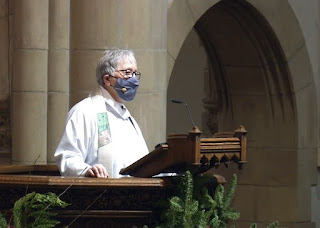
It was the Second Sunday of Christmas and the first Sunday after the passing of the inimitable Archbishop Desmond Tutu. The Omicron surge had driven us back to live-stream-only worship at All Saints Church in Pasadena ... and we added this excerpt from one of Archbishop Tutu's sermons to the lessons read at our 9:00 & 11:30 services.

And I got to preach.

It was quite a way to kick off 2022.


A Reading from Archbishop Desmond Tutu

You are family. You are the human family, God’s family.
You and I, knowing ourselves to be the sinners that we are,
are given the incredible privilege of addressing God –
the all holy God, the omnipotent God,
the God who dwells in light unapproachable,
from whom the angels and archangels veil their sight,
as they worship and adore God ceaselessly,
crying “Holy, holy, holy, Lord God of hosts –
and you and I are able to say to this one, “Abba, abba.”
We are meant to have the intimacy of a little child.
This family has no outsiders.
Everyone is an insider.
When Jesus said,
“I, if I am lifted up, will draw . . .”
Did he say, “I will draw some”?
Did he say, “I will draw some, and tough luck for the others”?
He said, “I, if I be lifted up, will draw all.”
All! All! All! –
Black, white, yellow; rich, poor;
clever, not so clever; beautiful, not so beautiful.
All! All! It is radical. All!
All are to be held in this incredible embrace.
Gay, lesbian, so-called “straight;” all! All!
All are to be held in the incredible embrace of the love that won’t let us go.


January 2, 2022 “The Love That Won’t Let Us Go”

This family has no outsiders.
Everyone is an insider.
All are to be held in the incredible embrace
of the love that won’t let us go
. Amen.

We gather this first Sunday of the New Year here at All Saints Church in Pasadena in the shadow of the loss of a global giant of love, justice and compassion as we continue to mourn the death of Archbishop Desmond Tutu.

Ninety years old and in frail health, the fact that his passing to the other realm was not unexpected does not lessen its impact -- for it feels almost impossible to imagine a world without the north star of his courage, wisdom and impish humor shining in our world.

Nevertheless, we persist. We grieve his loss and we celebrate his life ... and we remember his indomitable spirit and faithfulness to the good news of the one who loved us enough to become one of us in order to show us how to love one another. For if Archbishop Tutu's life was about any one thing it was about the power of that love to transform absolutely anything and anyone.

In 1994 Archbishop Tutu spoke to our Episcopal Church's General Convention in Indianapolis. We gathered in a cavernous convention hall with probably 3000 people -- and from the back-bench bleachers where my seminarian self was sitting he was a tiny speck of a man who filled up the whole room. I remember leaving the hall feeling like I was the luckiest person on earth to have actually been in the same room with such holy wisdom and courageous energy.

Over the years I was blessed several other opportunities to be in the presence of "the Arch."

In 2005 he returned to All Saints Church for a visit. We were at that point in the midst of the worst of the Anglican Inclusion Wars with the Episcopal Church on the verge of being voted off the Anglican Island for allowing the election and consecration of Gene Robinson as the Bishop of New Hampshire.

It was in that context of controversy, challenge and division that Archbishop Tutu preached the sermon from which this morning's reading was excerpted ... a sermon that was quintessential Tutu with its message of love, inclusion and challenge -- challenge for us to become the change we want to see in the world.

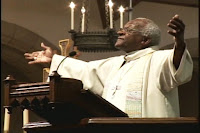
The moment that remains etched in my memory forever was when he stretched his arms out wide in this very pulpit and proclaimed:

It is radical.
All are to be held in this incredible embrace.
Gay, lesbian, so-called “straight” ...


It really was radical. So radical it elicited a literal gasp that rippled through the filled-to-the-rafters church ... a moment I described to a reporter earlier this week as "a gasp of amazement and relief and delight. For when you’re struggling on the margins, and the powers seem to be galvanizing against you, and you realize you have Desmond Tutu on your side, suddenly almost anything seems possible."

Much has changed in the years since that 2005 visit. There are now five gay or lesbian bishops in the Episcopal Church, the threats to vote us off the Anglican Island have died down and as we head to our upcoming General Convention marriage equality is part of our national church canons and there is an official LGBTQ Caucus -- things we couldn't even have imagined 16 years ago when the Arch stood in this pulpit and preached that sermon.

But much has sadly stayed the same. Division and polarization are -- if anything -- more entrenched than ever. Today as we once again gather virtually rather than in person in response to the Omicron surge, we cannot ignore that we also gather in the shadow of a pandemic that still holds us and those we love in a kind of ongoing limbo of vulnerability – and that too many beloved members of our families and communities are now absent from us.

We cannot hide from the fact that our nation is increasingly polarized, our democracy is inarguably under threat, that liberty and justice for all remains a pledge we make rather than a reality we live.

There are still miles to go before we rest in the work of dismantling the systemic marginalization of LGBTQ people in our church, our nation and our world.

And we cannot deny that over it all looms the existential challenge of the climate crisis that threatens this fragile Earth, our island home.

Nevertheless, we persist.

And this morning -- on this Second Sunday of Christmas on the Second day of the year of our Lord Two Thousand Twenty-two as we look ahead to year that promises to be full of both challenge and change, I can think of no better way to frame the work ahead of us than with these timeless words from Howard Thurman:

When the song of the angels is stilled,
when the star in the sky is gone,
when the kings and princes are home,
when the shepherds are back with their flocks,
the work of Christmas begins:
to find the lost,
to heal the broken,
to feed the hungry,
to release the prisoner,
to rebuild the nations,
to bring peace among the people,
to make music in the heart.

The work of Christmas is the work to which we are called 24/7 as we live out our call to be beacons of God's love, justice and compassion in our beautiful and broken world -- and in the year ahead we will have our hands full finding, healing, feeding, releasing, rebuilding, bringing and making ... reclaiming the planet an inch at a time until we truly become the kingdom come on Earth we pray for every time we gather.

Until the human race becomes the human family Desmond Tutu called us to be ... A family that has no outsiders ... where everyone is an insider ... and all are held in the incredible embrace of the love that won’t let us go.

And I am convinced on this Second Sunday of Christmas on the Second day of 2022 that how we do that work is as important as that we do that work.

Of all the memes I scrolled past on Instagram in the last few days while procrastinating whatever it was I procrastinating by scrolling through memes on Instagram the one that stuck with me was this:
The most important lesson I've learned over this past year is don't let anyone make you cruel. No matter how badly you want to give the world a taste of its own bitter medicine, it's never worth losing yourself
We face the two-fold challenge of resisting evil while not becoming the evil we deplore.

· Challenging those who perpetuate systemic injustice and oppression without dehumanizing them;
· Resisting those who feed, water and fertilize the polarization that plagues us without retreating to our own bubbles and silos;
· Rebutting those who ignore the very science that could help us end this pandemic and reverse the clock on the ticking time bomb of Climate Change while remembering that are all part of the same Big, Fat, Human Family.

In the words of one of the Tutu quotes making this rounds this week:
"If you want peace, you don't talk to your friends; you talk to your enemies."

It's a tall order ... but we stand on tall shoulders as we continue to learn from the work and witness of those who have gone before us in the struggle.

Sunday after Sunday we gather to hear their stories -- the ones preserved for us in our scriptural family album and the ones we tell and retell in sermons and forums and in conversations on the lawn.

And here's another one ... from the sermon preached yesterday at Archbishop Tutu's funeral in Cape Town by Bishop Michael Nuttall -- a sermon framed on the great call in Micah 6:8 to "do justice, love kindness, and walk humbly." Bishop Nutall said:
Love kindness. This was our ‘Arch’ at his very best. His was not a harsh, ideological quest for justice. Always it was grounded in mercy, in ‘hesed’ (to use the Hebrew word), in an enduring loving-kindness: the gentle touch, the forgiving heart, the warm smile – ah yes, the warm smile. Remember his fine book on the Truth and Reconciliation Commission ... was titled “No Future without Forgiveness”. How could someone who had suffered so much hostility and disdain in his own country settle for such a conviction, such magnanimity? It was because all that he stood for and strove for was undergirded by a spirit of mercy towards everyone.
Absolutely. Everyone.

It is radical. All are to be held in the incredible embrace of the love that won’t let us go.

That is the love Desmond Tutu preached about -- the love he not only proclaimed but embodied -- the fierce, powerful, both/and love of faith in action ... love the late bell hooks taught us "is an act of will – namely, both an intention and an action" -- the radical love that not only can but will

find the lost,
heal the broken,
feed the hungry,
release the prisoner,
rebuild the nations,
bring peace among the people,
make music in the heart.

Because no matter what powers seem to be galvanizing against that love, when and we remember we have both God and Desmond Tutu on our side ... suddenly absolutely anything seems possible.

Happy New Year. Amen.


Sunday, December 26, 2021

Remembering Archbishop Tutu


We lost a global giant of love, justice and compassion with the death today of Archbishop Desmond Tutu. Ninety years old and in frail health, the fact that his passing to the other realm was not unexpected does not lessen its impact -- for it feels almost impossible to imagine a world without the north star of his courage, wisdom and impish humor shining in our world.

Nevertheless, we persist. We grieve his loss and we celebrate his life ... and we remember his indomitable spirit and faithfulness to the good news of the one who loved us enough to become one of us in order to show us how to love one another. For if Archbishop Tutu's life was about any one thing it was about the power of that love to transform absolutely anything and anyone. 

In 1994 Archbishop Tutu spoke to our General Convention in Indianapolis. We gathered in a cavernous convention hall with probably 3000 people -- and from the back-bench bleachers where my seminarian self was sitting he was a tiny speck of a man who filled up the whole room. I remember leaving the hall feeling like I was the luckiest person on earth to have actually been in the same room with such holy wisdom and courageous energy.

Over the years I had several other opportunities to be in the presence of "the Arch." 

In 2005 -- in the midst of the Anglican Inclusion Wars -- he visited All Saints Church in Pasadena and preached a sermon where he famously said:

"Jesus did not say,
'I, if I be lifted up,
will draw some.'
Jesus said, 'I, if I be lifted up,
will draw all.'
All! All! All! All!
Black, white, yellow,
rich, poor,
clever, not so clever,
beautiful, not so beautiful.
It's one of the most radical things!
All, all, all belong.
Gay, lesbian, so-called straight.
All! All are meant to be held 
in this incredible embrace 
that will not let us go."

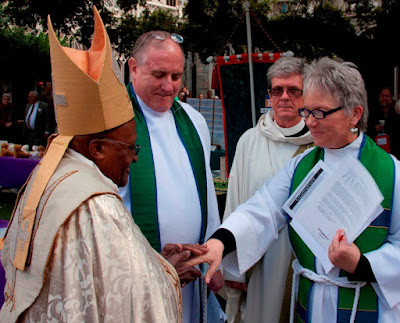
In 2011, Archbishop Tutu returned to All Saints. Taking my hand on the lawn before the service, he told me "All Saints Church stood with us in the fight against apartheid and we will stand with you in the fight against homophobia." 

It's a moment I'll never forget -- and a moment I'm so deeply grateful to Cyrus Davis for capturing in this picture.

"All are meant to be held in this incredible embrace that will not let us go." Rest in peace in that incredible embrace, Archbishop Tutu. As our Rector Emeritus George Regas would say: Oh, lucky heaven!

Friday, December 03, 2021

The Advent Waiting Game

This month I had the privilege of writing an Advent reflection for our diocesan clergy newsletter ... and having no idea where to start I wrote what I needed to hear: "The Advent Waiting Game" ... with thanks to Diana Bass & Liz Habecker for inspiration: 

With the lighting of yet another candle on yet another Advent wreath a new church year is launched, and we enter once more the season of waiting as we prepare to claim again the Christmas Truth greater than any of the traditions it inspires: the mystical longing of the creature for the creator – the finite for the infinite – the human for the divine. 

It is a longing that transcends culture, religion, language and custom – a longing that is represented for us as Christians in the baby in the manger – the sudden, amazing, and incomprehensible gift of grace: a God who loved us enough to become one of us. Yes, we manifest the wonder of Christmas in the gifts given, the meals shared, the gathering of family and loved ones. 

But the greater wonder is that the God who is love incarnate came down at Christmas to be among us as one of us: to show us how to share that love with a world in desperate need of it – to a world yearning for the “peace on earth, good will among all people” the angels proclaimed. 

And so we wait. And as we wait, I’m remembering many, many Advents ago our colleague Liz Habecker describing how “waiting” during Advent is different than any of the other kinds of “waiting” we do — waiting for a bus, for example. Waiting for a bus is both boring and anxiety-producing. Will it be on time? Will I make my connection? Am I even waiting at the right bus stop? What if I looked at the schedule wrong? Where is that bus, anyway? That’s waiting in anxiety. 

Advent waiting is more like being in the concert hall or theater, waiting for the curtain to rise. We know something wonderful is about to happen and everyone else is waiting with the same expectation. We know what we’re waiting for — we’ve bought the tickets and looked over the program — but the experience is yet to happen: and so we wait — expectantly. We wait in the tension of both knowing and NOT knowing — open to the experience about to unfold that is somehow different every time. We wait in anticipation rather than anxiety. 

And so another Advent begins. 

We light that first candle, and we wait. We wait in both trust and tension as we pray the familiar prayers, read the familiar lessons, and sing the familiar hymns. And yet for all the comfort of the familiarity of those beloved prayers, hymns, and lessons there can be no escaping the reality that this year … this moment that Canon Melissa described in her recent Angelus article as the “current normal” … is different. 

We cannot ignore that we wait in the shadow of a pandemic that may be loosening its grip but still holds us and those we love in a kind of ongoing limbo of vulnerability. We cannot hide from the fact that our nation is increasingly polarized, our democracy is inarguably under threat, that liberty and justice for all remains a pledge we make rather than a reality we live -- and that over it all looms the existential challenge of the climate crisis that threatens this fragile Earth, our island home. 

And so this Advent I take great comfort in these words from our friend, author Diana Butler Bass, who writes: 

Advent recognizes a profound spiritual truth: 
that we need not fear the dark. 

Instead, wait there. 
Under that blue cope of heaven, 
alert for the signs of dawn. 

Watch. 
For you cannot rush the night. 
But you can light some candles. 
Sing some songs. 
Recite poetry. 
Say prayers.

We cannot rush the night. But we can light some candles – and this year we can light those candles in person, rather than on Zoom. We can sing some songs – and this year we may have to sing them into our masks, but at least we get to sing them together. And we can recite poetry and say our prayers – sharing and offering words of inspiration and aspiration as we wait expectantly for the coming of the one who loved us enough to become one of us in order to show us how to love one another. 

And so my prayer for all of us in this time of holy waiting is that we will be given the grace to wait in expectation rather than anxiety – and that our work and our worship will be outward and visible signs of hope, peace, joy, and love to our beautiful and broken world … the Advent and always. 


Wednesday, December 01, 2021

Again With the Prayerfully Pro-Choice Post

 
The arguments before the Supreme Court are over and the deliberations have begun re: Dobbs v. Jackson’s Women’s Health – the latest battle in the war to overturn Roe v. Wade and eviscerate access to safe and legal abortion for people seeking reproductive health care.

And this time they are likely to win. 

It is a moment that does not come as a surprise as we have watched the orchestrated efforts of those who would return seek to control the bodies of others work out their long-game strategy over not just years but decades – including literally stealing a Supreme Court seat in order to pack the Court with opponents of reproductive freedom. 

Over the years we have suited up and stood up and spoken up and marched, lobbied and agitated more times than I can count to preserve what has been a constitutionally protected right since 1973 – my freshman year in college. I was honored to serve a four-year term as a member of the National Planned Parent Clergy Advocacy Board and continue to support that important work whenever and wherever I can. 

That support includes engaging with folks who are unable to reconcile my position as a pro-choice advocate with my vocation as a priest and pastor. One commenter summed it up tersely: "What kind of religion do you represent, lady?" 

The answer is that I represent one which gives me room to be both proudly and prayerfully pro-choice.

In 1988 the Episcopal Church went on record with a powerful statement affirming its commitment to both the sanctity of life and a woman's right to reproductive freedom. 

And then, in 1994, as the anti-abortion movement mobilized to restrict reproductive freedom of American women, we added this "further resolve": 
"The Episcopal Church express its unequivocal opposition to any legislative, executive or judicial action on the part of local, state or national governments that abridges the right of a woman to reach an informed decision about the termination of pregnancy or that would limit the access of a woman to safe means of acting on her decision."
That's the "religion I represent" -- one that acknowledges there is tension between the sacredness of life we affirm and the freedom of choice we support. And the parish I represent -- All Saints Church in Pasadena -- is one that has been officially "prayerfully pro-choice" since 1989.

And here we are again. La lucha continua … the struggle continues. As I posted on Twitter this morning:
"If what is happening in the Supreme Court this morning does not mobilize every single person committed to reproductive freedom to get to the polls for the 2022 Midterms then The Handmaid’s Tale becomes prophesy rather than fiction and we become Gilead. And we are not going to let that happen."
So buckle up. Say your prayers. Dig out the protest signs and pussy hats. Figure out who’s running for what and how to support them. Give to Planned Parenthood. Make some noise.

They may win this battle – but they will not win the war. Not on our watch.

[photo: All Saints contingent -- including our late Rector Emeritus George Regas -- at a 2019 "Stop the Bans" rally at Pasadena City Hall]

Thursday, November 25, 2021

A Sermon for Thanksgiving Eve 2021

A Sermon for Thanksgiving Eve 2021 at All Saints Church, Pasadena … with thanks to Diana Bass, Michael Curry, Sharon Brous and Joy Harjo.

The familiar trappings of Thanksgiving are all around us. Here at All Saints this evening we gather in this familiar sacred space, sing the familiar hymns, and pray the familiar prayers. In the days leading up to this evening, we have been culturally bombarded by the familiar signs of the season -- including the ubiquitous "pumpkin spicing" of almost everything. And -- here in Pasadena -- the most familiar sign of them all: the rising of the Rose Parade bleachers along Orange Grove Boulevard.

And for all the comfort of the familiarity there can be no escaping the reality that this year is not “Thanksgiving as usual.”

We cannot ignore that we also gather in the shadow of a pandemic that may be loosening its grip but still holds us and those we love in a kind of ongoing limbo of vulnerability – and that too many beloved members of our families and communities are now absent from us.

We cannot hide from the fact that our nation is increasingly polarized, our democracy is inarguably under threat, that liberty and justice for all remains a pledge we make rather than a reality we live.

And we cannot deny that over it all looms the existential challenge of the climate crisis that threatens this fragile Earth, our island home.

Nevertheless, we persist. Nevertheless, we choose to give thanks. And one of the things I give thanks for are these words from Diana Butler Bass:

“God, there are days we do not feel grateful. When we are anxious or angry. When we feel alone. When we do not understand what is happening in the world, or with our neighbors. God, we struggle to feel grateful.

But this Thanksgiving, we choose gratitude. We choose to accept life as a gift from you, from the unfolding work of all creation. We choose to be grateful for the earth from which our food comes; for the water that gives life; and for the air we all breathe.

We make the choice to see our ancestors, those who came before us, and their stories, as a continuing gift of wisdom for us today. We choose to see our families and friends with new eyes, appreciating them for who they are, and be thankful for our homes whether humble or grand. We choose to see the whole planet as our shared commons, the public stage of the future of our race and creation
.”

So I'm not a morning television person.
I'm a let's have it quiet around here until I've had a second cup of coffee person.

But today I got a heads up from my east coast friends on Facebook that two of my favorite people on the planet – Presiding Bishop Michael Curry and Rabbi Sharon Brous – were going to be on the Today Show … so I turned it on. (And if you missed it, check out All Saints Facebook Group … I posted a link to the segment clip.)

What stood out to me in the 6 minutes of wisdom from these two great spiritual leaders was how grounded they both were in their respective faith traditions -- and how in alignment they both were in their message of putting that faith in to action.

Rabbi Brous called listeners to recognize the vulnerability of this moment of shared recognition of the fragility and preciousness of life and to hold that vulnerability as a call to live differently in the world. “Our work” she said, “is to mitigate against the darkness by bringing light.”

And Bishop Curry noted that Thanksgiving is made up of two words: that thanks is an attitude and giving is an action. And the call he made was to do both in such a way that “we deal with the problems of our past in order to solve the problems of our present in order to create a better future for every member of the human family.”

So on this Thanksgiving Eve we not only give thanks: we choose to put into action the powerful words of Poet Laureate Joy Harjo* in this evening’s reading:

“All acts of kindness are lights in the war for justice.”

The war for justice is a battle over those would polarize us by fear and division -- and the weapons we are called to use are weapons of mass reconciliation: truth and justice; peace and love.

All acts of kindness are lights in the war for justice … and as that war continues to rage around us, we pause along the way to mark the incremental victories in order to keep us moving forward in the journey … this evening remembering especially:

• Justice for the family of Ahmaud Arbery … even as we work to dismantle the systemic white supremacy that led to his tragic death; and
• Gratitude for the exoneration of Kevin Strickland … even as we challenge the justice system that held him for 43 years for crime he didn’t commit.

In the face of the daunting challenges
of pandemics and polarization,
injustice and inequality
we choose to remember that
we belong to the God who created us in God’s image
because God wanted relatives –
that the God who spun the sun and moon and stars
and is mother, father, brother, sister and sibling to us all
gives us what we need to keep us from giving up
in this land of nightmares which is also the land of miracles –
calls us to gather up the strands broken from the web of life
and make them into something holy.
Something whole. Something beautiful.

When I first read those words of Joy Harjo I was immediately reminded of what we do when we gather at this table to receive the bread made holy … of the words of the old hymn:

“As grain, once scattered on the hillsides,
was in this broken bread made one,
so from all lands thy people gathered
into thy kindom by thy love
.”

And so as we prepare to gather at the table which is the center of our life in Christ, may we also prepare for action we go out from that table into the world as beacons of God’s love, justice, and compassion

On this Thanksgiving Eve may we be given grace live out both the attitude and the action of Thanks Giving -- to be the change we want to see in the world as we continue to choose both gratitude and love; as we act as lights in the war for justice.

Let us close with this prayer from Diana Butler Bass:

“God, this Thanksgiving, we do not give thanks. We choose it. And we will make thanks, with strong hands and courageous hearts. When we see your sacred generosity, we become aware that we live in an infinite circle of gratitude.

We will not let anything opposed to love take over this table. Instead, we choose to see grace, free and unmerited love, the giftedness of life everywhere, as the tender web of all creation. In this choosing, and in the making, we will pass gratitude onto the world.

Thus, with you, and with all those gathered here, we pledge to make thanks. And we ask you to strengthen us in this resolve. Here, now, and into the future. Around this table. Around the table of our nation. Around the table of the earth. Amen.
”

======

*Reconciliation - A Prayer by Joy Harjo
http://www.hanksville.org/storytellers/joy/poems/reconciliation.html

Thanksgiving Prayer 2016 - Diana Butler Bass
https://day1.org/articles/5d9b820ef71918cdf2004001/diana_butler_bass_a_thanksgiving_prayer_for_2016_choose_gratitude